
|
FYI - A-1 Miller's Performance Enterprises is a legal, legitimate, tax paying and reputable business. And as of 2024, A-1 Miller's Performance Enterprises is still in business and offering all parts and services listed in this website. Please click here to contact A-1 Miller's Performance Enterprises to place an order, send your parts for repairing, if you need a part or parts, or service(s) performed that's not listed or mentioned in this website, and/or for FREE professional and honest technical customer service assistance and support and payment options. |
 |
How to Rebuild and Improve the Cub Cadet Garden Tractor Drive Clutch Assembly |
 |
Inspiring Small Engine, Lawn & Garden, and Garden Pulling Tractor
Enthusiasts Since 1996. Where Science and Common Sense Come Together for
Safety and Improved Engine/Tractor Performance
A-1
Miller's Performance Enterprises - Parts & Services Online
Catalog
| IH Cub Cadet Garden Tractor Mechanical PTO Clutch Rebuild Kits, Rebuilt PTO Clutches and Rebuild Service |
This page was last updated 1/29/21 (Click Refresh to see changes or updates.) Optimized for 1024 x 768 screen resolution. To search for a word or phrase in any of my web sites, press CTRL and F simultaneously to open the Find dialog box in your web browser. Although every effort have been taken to check the accuracy of information contained herein, I cannot assume responsibility for errors.
NEW! A-1 Miller's Professional Automotive Engine Rebuilding and Modification Services. And Build You a Competitive Mini Pulling Truck and Big Wheel Mini Rod Pulling Tractor. Chevrolet, GMC, Chrysler, Ford, Diesel engines, etc. More details and information coming later.
On the direct-drive Cub Cadet garden tractor, power from the engine is through the clutch and driveshaft assembly to the transaxle and to the rear tires. If the clutch is severely worn or if stock (OEM) parts may slip and little power or torque will be transferred, especially when using the tractor for competition pulling (especially with a big engine in a fast gear), gardening or to haul heavy loads. An engine in a competition pulling tractor that's built to the max or runs at high RPM or at wide open throttle produces a lot more torque than what the engineers at Cub Cadet originally anticipated for the driveline to handle. Therefore, the clutch assembly is the weak point (and the one-piece carrier and coarse spline axles), and will need to be reinforced and built up for strength for durability and to prevent slippage. Remember: towards the end of the track, if the tires don't spin or the engine bogs down, then the clutch will slip or something elsewhere in the driveline will possibly twist or break.
Types of Cub Cadet Garden Tractor Clutch Assemblies -
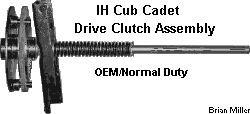
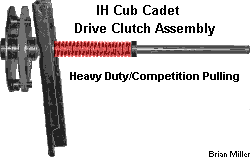
An ordinary clutch assembly for general lawn and garden use consist of a OEM quality steel driveshaft, composite clutch disc and an OEM pressure spring. But a clutch assembly for heavy lawn and garden use consist of a heavy duty 3- or 6-pin drive plate, either high strength steel or stainless steel driveshaft, either a single aftermarket composite clutch disc or a single aluminum clutch disc, and definitely a much stiffer pressure spring for placing a heavier load against the clutch disc. Also, the OEM Cub Cadet garden tractor pressure plates will definitely need to be trued-up in a metal lathe (with a self-centering 3-jaw chuck) so they'll be perfectly round and resurfaced until perfectly flat for better clutch adhesion. Because new OEM pressure plates are made of stamped steel and are not machined whatsoever. This means they are not perfectly flat and they wobble from the factory when new. If used OEM pressure plates have not been resurfaced before, then chances are, they'll still be thick enough after being resurfaced. Always remove the minimal amount of metal to retain maximum thickness so they will not warp when hot. (IMPORTANT: If you don't feel comfortable using a metal lathe, please consult a professional and experienced machinist with a lathe.) The same happens to automotive flywheels and pressure plates as the clutch disc wears. They need to be resurfaced too, when installing a new clutch disc. And the heavier or stronger the clutch assembly is, the more it will cost. By the way - if the rotating clutch parts are precision balanced, installed and adjusted correctly, the OEM Cub Cadet or aftermarket garden tractor composite clutch disc setup should last a long time, a lot longer than the popular aftermarket 3 puck metallic clutch disc.
Cub Cadet made four different 3-pin clutch drive plates. The bolt-circle pattern for the three clutch disc drive pins/partially threaded studs and four mounting holes are the same for all drive plates listed below.
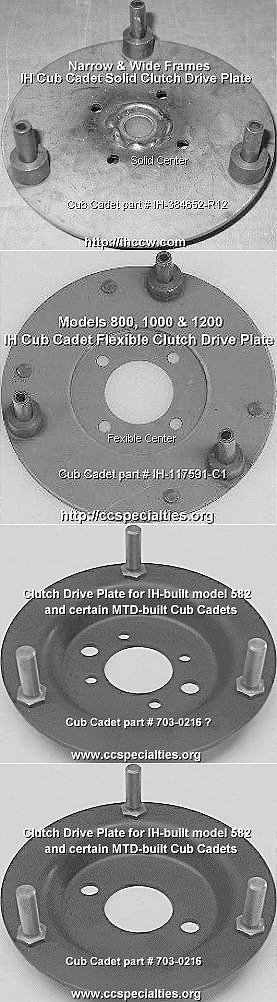 The first clutch drive plate
is designed for the IH-built narrow- and wide-frame Cub Cadet garden tractor
models 70, 71, 72, 73, 100, 102, 104, 106, 122, 124, 126, 86, 108 and 128
with a solid-mounted engine. It's made of flat, solid/non-flexible, 1/8"
thickness steel, with a bronze bushing (pilot bearing) pressed in the center
to support the driveshaft, and have coiled/spiral
pins to drive the clutch disc. This type of drive plate can also be used
on the Cub Cadet "Quiet Line" rubber ISO-mounted engine garden tractors (listed
below Ê) as long as
solid motor mounts are installed. It's Cub
Cadet part # IH-384652-R12.
The first clutch drive plate
is designed for the IH-built narrow- and wide-frame Cub Cadet garden tractor
models 70, 71, 72, 73, 100, 102, 104, 106, 122, 124, 126, 86, 108 and 128
with a solid-mounted engine. It's made of flat, solid/non-flexible, 1/8"
thickness steel, with a bronze bushing (pilot bearing) pressed in the center
to support the driveshaft, and have coiled/spiral
pins to drive the clutch disc. This type of drive plate can also be used
on the Cub Cadet "Quiet Line" rubber ISO-mounted engine garden tractors (listed
below Ê) as long as
solid motor mounts are installed. It's Cub
Cadet part # IH-384652-R12.
Depending on the class your tractor is going to pull in and engine size/modifications, there are many variations in which clutch/driveshaft design and carrier/axles to use. Listed are the weakest to the strongest:
Using Quality Driveshaft Material Is Important!
 Most driveshafts are likely to
break at the second coiled/spiral pin hole, just in front of the
clutch release/throw-out bearing. Because
that's where the most vibration usually occurs. They also break just behind
the pressure spring, in front of the
pillow block bearing, due to temporary
frame twisting (narrow frames) when pulling. If this happens, it's best to
install a split clamping/locking collar.
Most driveshafts are likely to
break at the second coiled/spiral pin hole, just in front of the
clutch release/throw-out bearing. Because
that's where the most vibration usually occurs. They also break just behind
the pressure spring, in front of the
pillow block bearing, due to temporary
frame twisting (narrow frames) when pulling. If this happens, it's best to
install a split clamping/locking collar.
What mainly makes the driveshaft break at 4,000+ RPM is either...
If quality driveshaft material is used, and if the rotating parts are precision balanced and if a carrier bearing is also installed (above 4,000 RPM. The factory setting of maximum RPM for virtually all small gas engines, including all of Kohler engines is 3,600), the driveshaft could possibly last the life of the tractor. Even when used in high-performance conditions.
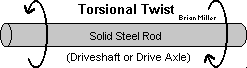
Remember, in the direct-drive Cub Cadet garden tractor, the entire clutch/driveshaft assembly rotates the same speed as the engine. For reliability in a highly modified tractor that turns well above 4,000 RPM, the driveshaft must be made of quality, solid hardened steel that can resist torsional twist. Such as high strength 1144 stress proof steel, heat-treated 4140 chrome-moly steel or ultra tough 304 alloy stainless steel.
Advertisement: (Prices are subject to change without notice.)
Click here to contact A-1 Miller's Performance Enterprises to place an order, send your parts for repairing, and/or for FREE professional and honest technical customer service assistance and support and payment options. Please contact A-1 Miller's if you need a part or parts, or service(s) performed that's not listed or mentioned in this website. Professionally Rebuilt Fully Assembled and Ready to Install Drive Clutch Assemblies for IH- and MTD-Built Cub Cadet Garden Tractors listed below. For general lawn and garden use, heavy towing, pushing snow or competition pulling. All A-1 Miller's clutch assemblies are build or rebuilt to give good service and last a long time. A-1 Miller's also offers rebuilding of the plain stock IH Cub Cadet "Original" garden tractor clutch assembly, OEM Cub Cadet garden tractor clutch assemblies, and heavy duty and/or competition garden pulling tractor clutch assemblies! We can rebuild your clutch assembly however you want it, if you don't mind sending it to us. Include a note with your contact information, tell us how you're going to use your tractor and we'll build or rebuild your clutch to suit your needs. We also offer individual clutch parts for the do-it-yourself rebuilders. Drive clutch assemblies listed below for narrow and wide, spread frame Cub Cadet garden tractors for general yard and garden use. Parts include: New high strength 1144 stress proof steel driveshaft, new coiled/spiral pins, new aftermarket composite clutch disc, new aftermarket throw-out bearing, reconditioned release lever, new main pressure spring, new teasing [compression] spring and protective thrust washer, and both OEM pressure plates trued-up in a metal lathe (with a self-centering 3-jaw chuck) so they'll be perfectly round and resurfaced until perfectly flat for better clutch adhesion. 3-pin drive plate shown in pictures shown above not included with clutch assemblies. All clutch purchases do not include the rear coupler or coupler arms and flex coupler. Purchase these separately, if needed. When ordering, please state model number of Cub Cadet garden tractor. Core trade-in must be in rebuildable condition with very few missing or damaged parts. *The price to build or rebuild your clutch assembly depends on which parts can be reused and which new parts are installed, and the amount of machining is required. IMPORTANT: Before reinstalling the driveshaft/clutch assembly in the tractor, apply automotive grease inside the pilot bushing and/or on the front of the driveshaft. Because if either is dry, chances are, the driveshaft can bind up in the bushing, the clutch may not release, and cause severe wear to both the bushing and driveshaft.
Drive Clutch Assemblies for Cub Cadet "Original" Garden Tractor. Priced full length (without creeper drive) or short length (with creeper drive unit.) NOTE: Complete driveshaft assembly do not include the driveshaft bearing support assembly, clutch operating support, clutch shaft bearing retainer and collar, adjustment rod yoke end, clutch operating rod and transaxle input shaft coupler arm. And due to supply and demand, and different lengths and applications, I do not keep complete rebuilt clutch assemblies in stock. I build them as customers order them.
Drive Clutch Assemblies for Narrow Frame Cub Cadet Garden Tractor models 70, 71, 72, 73, 100, 102, 104, 106, 122, 124 and 126. Priced full length (without creeper drive) or short length (with creeper drive unit.) And due to supply and demand, and different lengths and applications, I do not keep complete rebuilt clutch assemblies in stock. I build them as customers order them.
Drive Clutch Assemblies for Cub Cadet Wide Frame Garden Tractor models 80, 108 and 128. Priced full length (without creeper drive) or short length (with creeper drive unit.) And due to supply and demand, and different lengths and applications, I do not keep complete rebuilt clutch assemblies in stock. I build them as customers order them.
Drive Clutch Assemblies for Cub Cadet Wide Frame Garden Tractor models 800, 1000 and 1200. Priced full length (without creeper drive) or short length (with creeper drive unit.) And due to supply and demand, and different lengths and applications, I do not keep complete rebuilt clutch assemblies in stock. I build them as customers order them.
Drive Clutch Assemblies for Cub Cadet Spread Frame Garden Tractor models 580, 582, 1250, 1450, 1650 (models with a hydrostatic disconnect attachment), 1604, 1606 and 1806. Priced full length (without creeper drive) or short length (with creeper drive unit.) And due to supply and demand, and different lengths and applications, I do not keep complete rebuilt clutch assemblies in stock. I build them as customers order them.
Drive Clutch Assemblies to Replace or Convert [to Clutch Drive] Cub Cadet Spread Frame Garden Tractor models 482, 580, 582, 582 Special, 680, 682, 782, 782D, 882, 982, 984, 986, 1050, 1202, 1204, 1210, 1282, 1340, 1440, 1512, 1535, 1541, 1572, 1604, 1606, 1641, 1710, 1711, 1712, 1772, 1782, 1806, 1810, 1811, 1812, 1860, 1861, 1862, 1863, 1864, 1872, 1882, 1912, 1914, 2072, 2082, 2086, 2182 and 2284. Priced full length (without creeper drive) or short length (with creeper drive unit.) 3-pin drive plate, hanger support bracket and adjustment rod/spring to convert a hydrostatic drive into the clutch drive is extra charge. And due to supply and demand, and different lengths and applications, I do not keep complete rebuilt clutch assemblies in stock. I build them as customers order them.
Drive Clutch Assembly for Cub Cadet Spread Frame Garden Tractor model 1050. Priced full length (without creeper drive) or short length (with creeper drive unit.) And due to supply and demand, and different lengths and applications, I do not keep complete rebuilt clutch assemblies in stock. I build them as customers order them.
|
||||||
| Click here to contact A-1 Miller's Performance Enterprises to place an order, send your parts for repairing, and/or for FREE professional and honest technical customer service assistance and support and payment options. Please contact A-1 Miller's if you need a part or parts, or service(s) performed that's not listed or mentioned in this website. | [Top of Page] | ||||||
MTD Farm King Drive Clutch Discs. Each
fits
MTD Farm King garden tractor model 960 and Cub Cadet garden
tractors. [Top of Page]
A-1 Miller's Professional Drive Clutch Assembly and Gearbox Rebuild Service for MTD Farm King garden tractor model 960. NOTE: Being most OEM replacement parts for the MTD Farm King clutch assembly are no longer available from any source, the rebuild price varies depending on which parts needs to be replaced, fabricated and/or repaired. All rebuilds come with a limited lifetime warranty. $800.00± for parts and labor, plus return shipping & handling.
Drive Belt. Fits Cub Cadet garden tractor models 482, 580, 582 Special, 1100, 1204 and 1604. This V-belt goes from the Peerless right-angle gearbox to the Peerless transaxle.
|
||||||
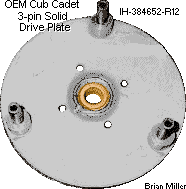 OEM
Cub Cadet Garden Tractor 3-Pin Solid Clutch Drive Plate.
Designed for IH-built Cub Cadet garden tractor models 70, 71, 72, 73, 86,
100, 102, 104, 108, 122, 124, 126 and 128 with the solid-mounted engine.
These models have the engine fastened directly to the frame with no rubber
motor mounts. If you want to use this type of drive plate in a "Quiet Line"
model 800, 1000 or 1200 with the ISO-mounted engine, then a set of A-1 Miller's
solid motor mounts must also be installed,
making the clutch/driveshaft assembly rigid throughout so less wear will
occur to the clutch assembly. IMPORTANT: To prevent the pilot bushing
(and holes in the clutch disc) from wearing excessively, it's highly recommended
that your OEM pressure plates be trued-up (and resurfaced until perfectly
flat for better clutch adhesion) in a
metal lathe. And before reinstalling the driveshaft/clutch
assembly in the tractor, apply automotive grease inside the pilot bushing
and/or on the front of the driveshaft. Because if either is dry, chances
are, the driveshaft will wear the bushing excessively or bind up in the bushing,
and the clutch may not release. OEM
Cub Cadet Garden Tractor 3-Pin Solid Clutch Drive Plate.
Designed for IH-built Cub Cadet garden tractor models 70, 71, 72, 73, 86,
100, 102, 104, 108, 122, 124, 126 and 128 with the solid-mounted engine.
These models have the engine fastened directly to the frame with no rubber
motor mounts. If you want to use this type of drive plate in a "Quiet Line"
model 800, 1000 or 1200 with the ISO-mounted engine, then a set of A-1 Miller's
solid motor mounts must also be installed,
making the clutch/driveshaft assembly rigid throughout so less wear will
occur to the clutch assembly. IMPORTANT: To prevent the pilot bushing
(and holes in the clutch disc) from wearing excessively, it's highly recommended
that your OEM pressure plates be trued-up (and resurfaced until perfectly
flat for better clutch adhesion) in a
metal lathe. And before reinstalling the driveshaft/clutch
assembly in the tractor, apply automotive grease inside the pilot bushing
and/or on the front of the driveshaft. Because if either is dry, chances
are, the driveshaft will wear the bushing excessively or bind up in the bushing,
and the clutch may not release.
|
||||||
 Cub Cadet Garden Tractor
3-Pin Flexible Center Clutch Drive Plate. Designed for IH-built
Cub Cadet garden tractor "Quiet Line" models 800, 1000 and 1200, including
models 1250, 1450 and 1650 with a hydrostatic disconnect attachment. All
these models have a rubber ISO-mounted engine to
reduce vibration throughout the tractor for operator comfort. IMPORTANT
- To maintain balance of this particular drive plate, one spiral pin is longer
than the other two - do not grind it down! And both pressure plates should
be trued-up (and resurfaced until perfectly flat for better clutch adhesion)
in a metal lathe to prevent the possibility of breakage. FYI - The OEM Cub
Cadet clutch pressure plates are made of stamped steel, which makes them
somewhat oblong or "egg-shaped" and not machined perfectly round, which causes
the clutch disc and drive plate to wear and eventually break. This is what
causes the pilot bushing to prematurely wear. And before reinstalling the
driveshaft/clutch assembly in the tractor, apply automotive grease inside
the pilot bushing and/or on the front of the driveshaft. Because if either
is dry, chances are, the driveshaft can bind up in the bushing, the clutch
may not release, and cause severe wear to both the bushing and driveshaft.
Replaces discontinued Cub Cadet flexible drive plate part # IH-106545-C93. Cub Cadet Garden Tractor
3-Pin Flexible Center Clutch Drive Plate. Designed for IH-built
Cub Cadet garden tractor "Quiet Line" models 800, 1000 and 1200, including
models 1250, 1450 and 1650 with a hydrostatic disconnect attachment. All
these models have a rubber ISO-mounted engine to
reduce vibration throughout the tractor for operator comfort. IMPORTANT
- To maintain balance of this particular drive plate, one spiral pin is longer
than the other two - do not grind it down! And both pressure plates should
be trued-up (and resurfaced until perfectly flat for better clutch adhesion)
in a metal lathe to prevent the possibility of breakage. FYI - The OEM Cub
Cadet clutch pressure plates are made of stamped steel, which makes them
somewhat oblong or "egg-shaped" and not machined perfectly round, which causes
the clutch disc and drive plate to wear and eventually break. This is what
causes the pilot bushing to prematurely wear. And before reinstalling the
driveshaft/clutch assembly in the tractor, apply automotive grease inside
the pilot bushing and/or on the front of the driveshaft. Because if either
is dry, chances are, the driveshaft can bind up in the bushing, the clutch
may not release, and cause severe wear to both the bushing and driveshaft.
Replaces discontinued Cub Cadet flexible drive plate part # IH-106545-C93.
|
||||||
 A-1 Miller's Professional
Repair Service - Weld Spiral Pin Collars on YOUR OEM IH Cub Cadet Garden
Tractor Drive Plate. This adds approximately 85% more strength to prevent
from bending or flexing of drive plate while under severe strain from heavy
duty use or competition pulling. Labor include true-up drive plate in
metal lathe to remove wobble or run-out to reduce vibration.
We always perform this repair to a customer's drive plate, as part of the
complete clutch rebuild. IMPORTANT: To prevent the pilot bushing (and
holes in the clutch disc) from wearing excessively, it's highly recommended
that your OEM pressure plates be trued-up (and resurfaced until perfectly
flat for better clutch adhesion) in a
metal lathe. And before reinstalling the driveshaft/clutch
assembly in the tractor, apply automotive grease inside the pilot bushing
and/or on the front of the driveshaft. Because if either is dry, chances
are, the driveshaft will wear the bushing excessively or bind up in the bushing,
and the clutch may not release. An original, ingenious and innovative
concept by Brian Miller, because nobody else advertise this type of
service. A-1 Miller's Professional
Repair Service - Weld Spiral Pin Collars on YOUR OEM IH Cub Cadet Garden
Tractor Drive Plate. This adds approximately 85% more strength to prevent
from bending or flexing of drive plate while under severe strain from heavy
duty use or competition pulling. Labor include true-up drive plate in
metal lathe to remove wobble or run-out to reduce vibration.
We always perform this repair to a customer's drive plate, as part of the
complete clutch rebuild. IMPORTANT: To prevent the pilot bushing (and
holes in the clutch disc) from wearing excessively, it's highly recommended
that your OEM pressure plates be trued-up (and resurfaced until perfectly
flat for better clutch adhesion) in a
metal lathe. And before reinstalling the driveshaft/clutch
assembly in the tractor, apply automotive grease inside the pilot bushing
and/or on the front of the driveshaft. Because if either is dry, chances
are, the driveshaft will wear the bushing excessively or bind up in the bushing,
and the clutch may not release. An original, ingenious and innovative
concept by Brian Miller, because nobody else advertise this type of
service.
|
||||||
 A-1 Miller's Professional
Repair Service - Repair your OEM IH Cub Cadet garden tractor 3-pin clutch
drive plate when the three OEM drive pin collar(s) are broken off with three
or six hardened steel drive studs. No need to purchase another drive plate.
Work include true-up drive plate in
metal lathe to remove wobble or run-out to reduce vibration
and for precision alignment installation of drive studs. I can also do this
to repair a customer's drive plate, as part of the clutch rebuild.
IMPORTANT: To prevent the pilot bushing (and holes in the clutch disc)
from wearing excessively, it's highly recommended that your OEM pressure
plates be trued-up (and resurfaced until perfectly flat for better clutch
adhesion) in a
metal lathe. And before reinstalling the driveshaft/clutch
assembly in the tractor, apply automotive grease inside the pilot bushing
and/or on the front of the driveshaft. Because if either is dry, chances
are, the driveshaft will wear the bushing excessively or bind up in the bushing,
and the clutch may not release. An original, ingenious and innovative
concept by Brian Miller, because nobody else advertise this type of
service. A-1 Miller's Professional
Repair Service - Repair your OEM IH Cub Cadet garden tractor 3-pin clutch
drive plate when the three OEM drive pin collar(s) are broken off with three
or six hardened steel drive studs. No need to purchase another drive plate.
Work include true-up drive plate in
metal lathe to remove wobble or run-out to reduce vibration
and for precision alignment installation of drive studs. I can also do this
to repair a customer's drive plate, as part of the clutch rebuild.
IMPORTANT: To prevent the pilot bushing (and holes in the clutch disc)
from wearing excessively, it's highly recommended that your OEM pressure
plates be trued-up (and resurfaced until perfectly flat for better clutch
adhesion) in a
metal lathe. And before reinstalling the driveshaft/clutch
assembly in the tractor, apply automotive grease inside the pilot bushing
and/or on the front of the driveshaft. Because if either is dry, chances
are, the driveshaft will wear the bushing excessively or bind up in the bushing,
and the clutch may not release. An original, ingenious and innovative
concept by Brian Miller, because nobody else advertise this type of
service.
|
||||||
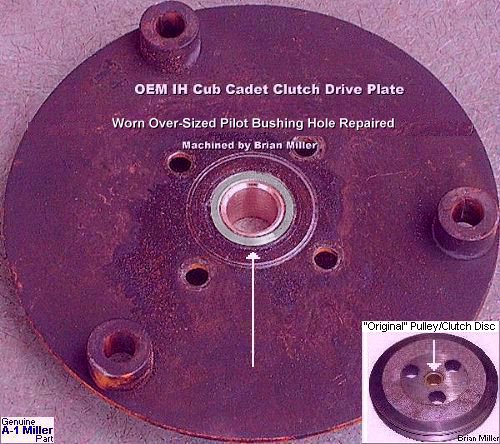 A-1 Miller's Professional
Repair Service - Repair Worn Over-Size Pilot Bushing Hole in YOUR IH
Cub Cadet Garden Tractor Drive Plate, or Repair Bushing in YOUR Cub Cadet
"Original" Garden Tractor Pulley/Clutch Disc for Installation of OEM-size
Pilot Bushing. No need to purchase another drive plate. Work include true-up
drive plate in
metal lathe to remove wobble or run-out to reduce vibration.
I can also do this to repair a customer's drive plate, as part of the clutch
rebuild. IMPORTANT: To prevent the pilot bushing (and holes in the clutch
disc) from wearing excessively, it's highly recommended that your OEM pressure
plates be trued-up (and resurfaced until perfectly flat for better clutch
adhesion) in a
metal lathe. And before reinstalling the driveshaft/clutch
assembly in the tractor, apply automotive grease inside the pilot bushing
and/or on the front of the driveshaft. Because if either is dry, chances
are, the driveshaft will wear the bushing excessively or bind up in the bushing,
and the clutch may not release. An original, ingenious and innovative
concept by Brian Miller, because nobody else advertise this type of
service. A-1 Miller's Professional
Repair Service - Repair Worn Over-Size Pilot Bushing Hole in YOUR IH
Cub Cadet Garden Tractor Drive Plate, or Repair Bushing in YOUR Cub Cadet
"Original" Garden Tractor Pulley/Clutch Disc for Installation of OEM-size
Pilot Bushing. No need to purchase another drive plate. Work include true-up
drive plate in
metal lathe to remove wobble or run-out to reduce vibration.
I can also do this to repair a customer's drive plate, as part of the clutch
rebuild. IMPORTANT: To prevent the pilot bushing (and holes in the clutch
disc) from wearing excessively, it's highly recommended that your OEM pressure
plates be trued-up (and resurfaced until perfectly flat for better clutch
adhesion) in a
metal lathe. And before reinstalling the driveshaft/clutch
assembly in the tractor, apply automotive grease inside the pilot bushing
and/or on the front of the driveshaft. Because if either is dry, chances
are, the driveshaft will wear the bushing excessively or bind up in the bushing,
and the clutch may not release. An original, ingenious and innovative
concept by Brian Miller, because nobody else advertise this type of
service.
|
||||||
| A-1 Miller's Professional Repair Service - Convert your OEM IH
or MTD Cub Cadet garden tractor clutch drive plate from 3-pin (IH) or 3-stud
(MTD) to 3-pin/3-stud or 6-stud. Work include true-up plate in
metal lathe to remove wobble or run-out to reduce vibration,
precision drill 3 new holes in exact spacing of OEM pins or studs, and then
install 3 additional hardened steel studs, lock washers and nuts. I can also
do this to repair a customer's drive plate, as part of the clutch rebuild.
NOTE: Clutch disc must be precision-drilled with 3 additional holes to
accept the 3 additional drive studs. IMPORTANT: To prevent the pilot bushing
(and holes in the clutch disc) from wearing excessively, it's highly recommended
that your OEM pressure plates be trued-up (and resurfaced until perfectly
flat for better clutch adhesion) in a
metal lathe. And before reinstalling the driveshaft/clutch
assembly in the tractor, apply automotive grease inside the pilot bushing
and/or on the front of the driveshaft. Because if either is dry, chances
are, the driveshaft will wear the bushing excessively or bind up in the bushing,
and the clutch may not release. An original, ingenious and innovative
concept by Brian Miller, because nobody else advertise this type of
service. $60.00 each drive plate, includes parts and labor, plus
return shipping & handling.
|
||||||
  Clutch Drive Studs w/nuts and split lock washers for Cub
Cadet garden tractors. IMPORTANT: Installing three additional
clutch drive stud in a drive plate is something that must be performed with
precision accuracy. And it's highly recommended that your OEM pressure
plates be trued-up in a
metal lathe (with a self-centering 3-jaw chuck) so they'll
be perfectly round (to reduce premature pilot bushing wear, and resurfaced
until perfectly flat for better clutch adhesion) to prevent premature wearing
of the new pilot bushing and drive pins in the drive plate, and holes in
the clutch disc. Clutch Drive Studs w/nuts and split lock washers for Cub
Cadet garden tractors. IMPORTANT: Installing three additional
clutch drive stud in a drive plate is something that must be performed with
precision accuracy. And it's highly recommended that your OEM pressure
plates be trued-up in a
metal lathe (with a self-centering 3-jaw chuck) so they'll
be perfectly round (to reduce premature pilot bushing wear, and resurfaced
until perfectly flat for better clutch adhesion) to prevent premature wearing
of the new pilot bushing and drive pins in the drive plate, and holes in
the clutch disc.
|
||||||
 Driveshafts
for IH Cub Cadet "Original" Garden Tractor. NOTE: These
driveshafts, with the OEM factory designed machined-down 3/8" diameter support
end, are originally used with Cub Cadet coupler arm with the 25/64" center
hole (part # 759-3009). But with a 5/8" diameter
support end (A-1 Miller's improved design), the driveshaft can be used instead
with Cub Cadet coupler arm with the 5/8" center hole (part
# 748-3001). Due to the increase in material, less wear will occur to
the end of the driveshaft and hole in the coupler arm. Available
only in stress proof steel. Please indicate with 3/8" or 5/8" stub end.
Driveshafts comes with flat steel coupler arm welded to shaft and coiled/spiral
pin holes drilled. Coiled/Spiral
pins listed below. Driveshafts
for IH Cub Cadet "Original" Garden Tractor. NOTE: These
driveshafts, with the OEM factory designed machined-down 3/8" diameter support
end, are originally used with Cub Cadet coupler arm with the 25/64" center
hole (part # 759-3009). But with a 5/8" diameter
support end (A-1 Miller's improved design), the driveshaft can be used instead
with Cub Cadet coupler arm with the 5/8" center hole (part
# 748-3001). Due to the increase in material, less wear will occur to
the end of the driveshaft and hole in the coupler arm. Available
only in stress proof steel. Please indicate with 3/8" or 5/8" stub end.
Driveshafts comes with flat steel coupler arm welded to shaft and coiled/spiral
pin holes drilled. Coiled/Spiral
pins listed below.
Driveshafts for MTD-built Cub Cadet Hydrostatic Drive Garden Tractor models 1872 and 2072. (Available only in stress proof steel.) Coiled/Spiral pins listed below.
Click here to contact A-1 Miller's Performance Enterprises to place an order, send your parts for repairing, and/or for FREE professional and honest technical customer service assistance and support and payment options. If you need a part or parts that's not listed in this website, please contact A-1 Miller's and we'll see if we can get it at a reasonable price. | [Top of Page]
3/16" Diameter Heavy Duty Coiled/Spiral Pins for IH Cub Cadet "Original" garden tractor driveshaft. 3,100 P.S.I. breaking strength.
1/4" Diameter Heavy Duty Coiled/Spiral Pins for all other models of Cub Cadet garden tractor driveshafts. 6,500 P.S.I. breaking strength.
3/8" Diameter x 1-1/2" Length Heavy Duty Coiled/Spiral Pin for OEM IH Cub Cadet narrow and wide frame garden tractor models 70, 71, 72, 73, 86, 100, 102, 104, 106, 108, 122, 124, 126 and 128 3-pin clutch drive plate and drag link steering arm, and driveshaft for MTD-built Cub Cadet garden tractor models 1872 and 2072. NOTE: The holes in the drag link steering arm and spindle shaft may need to be drilled (enlarged) exactly to 3/8" (.375") for this pin to fit snug. 12,600 P.S.I. breaking strength. $6.00 each, plus shipping & handling.
|
||||||
|
Advertisement: (Prices are subject to change without notice.)
| Click here to contact A-1 Miller's Performance Enterprises to place an order, send your parts for repairing, and/or for FREE professional and honest technical customer service assistance and support and payment options. Please contact A-1 Miller's if you need a part or parts, or service(s) performed that's not listed or mentioned in this website. |
 5/8"
I.D. One-Piece Split Clamping/Locking Collar. With the drilled 3rd
coiled/spiral pin hole not present in the driveshaft, this part stiffens
the driveshaft in the middle 100%, which helps to prevent driveshaft breakage
at 4,000 RPM (without a center pillow block bearing and support brace installed),
and when used with a center pillow block bearing and support brace, this
locking collar prevents the driveshaft from "wobbling around", which could
break at open RPM. Comes with two Allen head screws that secures clamp together
and provide a very tight uniform 360° grip around the driveshaft. NOTE:
With the hardened and "slick" surface of a stainless steel driveshaft, it's
best to use two one-piece split clamping/locking collars because just one
locking collar could slip rearward on the driveshaft when the clutch pedal
is depressed. $3.00 each, plus shipping & handling.
[Return to Previous Section, Paragraph
or Website] 5/8"
I.D. One-Piece Split Clamping/Locking Collar. With the drilled 3rd
coiled/spiral pin hole not present in the driveshaft, this part stiffens
the driveshaft in the middle 100%, which helps to prevent driveshaft breakage
at 4,000 RPM (without a center pillow block bearing and support brace installed),
and when used with a center pillow block bearing and support brace, this
locking collar prevents the driveshaft from "wobbling around", which could
break at open RPM. Comes with two Allen head screws that secures clamp together
and provide a very tight uniform 360° grip around the driveshaft. NOTE:
With the hardened and "slick" surface of a stainless steel driveshaft, it's
best to use two one-piece split clamping/locking collars because just one
locking collar could slip rearward on the driveshaft when the clutch pedal
is depressed. $3.00 each, plus shipping & handling.
[Return to Previous Section, Paragraph
or Website] |
 Driveshaft
Center Support Pillow Block with self-aligning 5/8" ball bearing and
high quality cast iron housing. For use in all models of IH- and MTD-built
Cub Cadet competition garden pulling tractors. 3-3/4" center to center mounting
holes. Use with steel support brace listed below. NOTE: This is
required only for Cub Cadet competition pulling tractors with an engine that
run at open RPM to stabilize the driveshaft from wobbling and prevent breakage.
The input shaft in the transaxle could break too, from the wobbling. Install
just behind main pressure spring on driveshaft. See picture below for correct
installation. [Return to Previous
Section, Paragraph or Website] Driveshaft
Center Support Pillow Block with self-aligning 5/8" ball bearing and
high quality cast iron housing. For use in all models of IH- and MTD-built
Cub Cadet competition garden pulling tractors. 3-3/4" center to center mounting
holes. Use with steel support brace listed below. NOTE: This is
required only for Cub Cadet competition pulling tractors with an engine that
run at open RPM to stabilize the driveshaft from wobbling and prevent breakage.
The input shaft in the transaxle could break too, from the wobbling. Install
just behind main pressure spring on driveshaft. See picture below for correct
installation. [Return to Previous
Section, Paragraph or Website]
|
 Do this only if the front
axle have been moved forward -
Do this only if the front
axle have been moved forward -
 On the narrow frame Cub Cadet garden tractors, if the front
axle have been moved forward, reinforce the frame rails where the engine
mounting holes are to reduce normal high-RPM engine vibration travel that
could lead to both frame and driveshaft breakage. To do so, stiffen the frame
rails where the engine mounting bolt holes are by welding two 1/4" thick
steel plates under the frame. Longer engine mounting bolts must be used,
too. The reason for this is because when the front axle center support is
moved, the remaining frame material isn't thick enough to hold up to the
engine vibration.
On the narrow frame Cub Cadet garden tractors, if the front
axle have been moved forward, reinforce the frame rails where the engine
mounting holes are to reduce normal high-RPM engine vibration travel that
could lead to both frame and driveshaft breakage. To do so, stiffen the frame
rails where the engine mounting bolt holes are by welding two 1/4" thick
steel plates under the frame. Longer engine mounting bolts must be used,
too. The reason for this is because when the front axle center support is
moved, the remaining frame material isn't thick enough to hold up to the
engine vibration.
For the spread frame models with the ISO (rubber) motor mounts, replace the rubber mounts with a set of our solid steel motor mounts or remove the brackets and fabricate a minimum 1/4" thick plate steel, set it at the right height and weld it to the frame. But the engine mounting holes and oil drain plug hole must be properly located (centered) and drilled in the plate first. This is much easier to do on a platform work table than on the floor or ground. [Return to Previous Section, Paragraph or Website]
|
|
|
|
|
|
How to Remove the Driveshaft/Clutch Assembly from a Cub Cadet Garden Tractor: (This is much easier performed on a platform work table than on the floor or ground.) (Updated 9/13/22)
The coiled/spiral pin in
the input shaft on the transaxle of a narrow frame Cub Cadet garden tractor
can be very difficult to remove and somewhat difficult to access from underneath.
Therefore, it's recommended that a 1" hole should be drilled through the
top of a short tunnel cover (center section of the tractor frame), or through
the side of a tall tunnel cover in direct alignment with the coiled/spiral
pin, then use a long 1/4" roll pin punch and medium size hammer to drive
the pin from the coupler. Don't attempt to drill-out the coiled/spiral pin.
They're just as hard as a high quality drill bit. After the pin is removed
and the clutch assembly is rebuilt, upon reinstallation in the tractor, use
a socket in the drilled hole to fasten a hardened steel 1/4" diameter
[grade 8 or Allen head] bolt in the coupler.
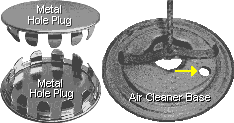 For cosmetic purpose, hide the
drilled hole with a 1" plastic or metal hole plug. Just push the plug in
the hole for a nice distinctive look. And sometimes when driving out
the coiled/spiral pin, the pounding will bend the input shaft in the transaxle.
If this happens, the input shaft will need to be straightened (and hope it
doesn't break later because the metal have been weakened) or a good used
input shaft will need to be installed. This is why it's highly recommended
that a hardened steel (grade 8) 1/4" bolt/lock nut be used in the coupler
in place of the coiled/spiral pin because if the driveshaft ever needs to
be removed again, removing a bolt/lock nut would be a lot easier than driving
out a stubborn coiled/spiral pin. Plus, it'll be easier on your nerves and
on the input shaft.
For cosmetic purpose, hide the
drilled hole with a 1" plastic or metal hole plug. Just push the plug in
the hole for a nice distinctive look. And sometimes when driving out
the coiled/spiral pin, the pounding will bend the input shaft in the transaxle.
If this happens, the input shaft will need to be straightened (and hope it
doesn't break later because the metal have been weakened) or a good used
input shaft will need to be installed. This is why it's highly recommended
that a hardened steel (grade 8) 1/4" bolt/lock nut be used in the coupler
in place of the coiled/spiral pin because if the driveshaft ever needs to
be removed again, removing a bolt/lock nut would be a lot easier than driving
out a stubborn coiled/spiral pin. Plus, it'll be easier on your nerves and
on the input shaft.
 On the IH-built models 800, 1000
and 1200, there's a 5/8" steel ball at the end of the driveshaft located
inside the rear flex arm coupler (with the bronze swivel bushing). Do not
lose this ball! It will need to be reused when reinstalling the clutch
assembly/driveshaft in the tractor. This ball is located at the end of
the driveshaft and inside the rear flex arm coupler (with the bronze swivel
bushing) and sometimes gets lost when removing the clutch assembly/driveshaft
from the tractor. It allows the driveshaft to "move side to side" with the
engine (that's mounted on rubber mounts). If it's left out, the clutch
assembly/driveshaft will move further back 5/8" when the clutch pedal is
depressed, and the clutch disc will not release and operate correctly. The
MTD-built models have no steel ball. The end of the [5/8" longer] driveshaft
is pointed, which fits in the pilot hole of the input shaft in the
transaxle.
On the IH-built models 800, 1000
and 1200, there's a 5/8" steel ball at the end of the driveshaft located
inside the rear flex arm coupler (with the bronze swivel bushing). Do not
lose this ball! It will need to be reused when reinstalling the clutch
assembly/driveshaft in the tractor. This ball is located at the end of
the driveshaft and inside the rear flex arm coupler (with the bronze swivel
bushing) and sometimes gets lost when removing the clutch assembly/driveshaft
from the tractor. It allows the driveshaft to "move side to side" with the
engine (that's mounted on rubber mounts). If it's left out, the clutch
assembly/driveshaft will move further back 5/8" when the clutch pedal is
depressed, and the clutch disc will not release and operate correctly. The
MTD-built models have no steel ball. The end of the [5/8" longer] driveshaft
is pointed, which fits in the pilot hole of the input shaft in the
transaxle.
How to Disassemble the Clutch Components from the Driveshaft -
To disassemble the clutch components from the driveshaft, first place the front pressure plate hub on slightly open jaws of a bench vise, and use a quality-made 1/4" coiled/spiral pin punch and a medium size hammer to drive out the coiled/spiral pin. Then the pressure plates, clutch disc clutch release/throw-out bearing and pressure spring should all slide off the driveshaft.
Fasten the Coupler Arms Together To Make One Rigid Driveshaft Coupler -
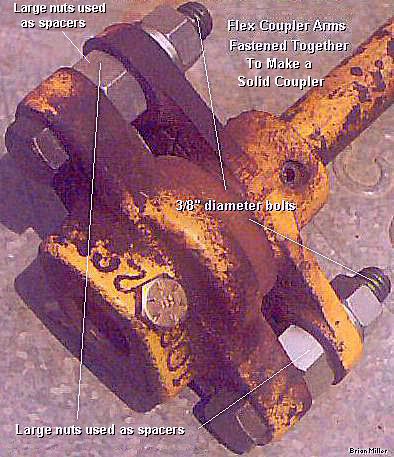 With
solid motor mounts installed in a Cub Cadet
"Quiet Line" garden tractor that originally came with a rubber ISO-mounted
engine, the driveshaft will not be able to "move" with the engine and there'll
be less chance of clutch parts prematurely wearing or breaking. The flexible
rubber disc(s) at the end of the driveshaft will be useless too, and could
deteriorate over time. So instead of replacing the OEM coupler arms with
a machined rigid tubular coupler, make the coupler arms rigid by removing
the flexible rubber disc(s) and install a couple of 3/8" thickness spacers
for a single disc, and a couple of 3/4" thickness spacers for double composite
clutch discs, and fasten the arms together with a couple of 3/8" diameter
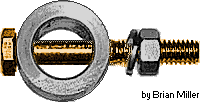
hardened steel bolts. (Large nuts are used as spacers in the photo to the
right.) By the way - one rubber flex disc is 3/8" thick. This setup is just
as strong as using a rigid tubular coupler, and it cost a lot less.
With
solid motor mounts installed in a Cub Cadet
"Quiet Line" garden tractor that originally came with a rubber ISO-mounted
engine, the driveshaft will not be able to "move" with the engine and there'll
be less chance of clutch parts prematurely wearing or breaking. The flexible
rubber disc(s) at the end of the driveshaft will be useless too, and could
deteriorate over time. So instead of replacing the OEM coupler arms with
a machined rigid tubular coupler, make the coupler arms rigid by removing
the flexible rubber disc(s) and install a couple of 3/8" thickness spacers
for a single disc, and a couple of 3/4" thickness spacers for double composite
clutch discs, and fasten the arms together with a couple of 3/8" diameter
hardened steel bolts. (Large nuts are used as spacers in the photo to the
right.) By the way - one rubber flex disc is 3/8" thick. This setup is just
as strong as using a rigid tubular coupler, and it cost a lot less.
If the outer parts of the
two arms don't come together or meet when the bolts are tightened (be careful
not to tighten the bolts too tight if the arms don't meet, they could break),
a couple of thin flat washers may need to be added as shims next to the spacers.
And before fastening the arms together with the spacers, first slide the
arms on the driveshaft so they'll be in perfect alignment with each other,
and tighten the bolts. See the photo to the right ->. Also, if you want,
leave out the 5/8" diameter [swivel/spacer] steel ball. It'll serve no purpose
when using solid motor mounts and when making
the coupler arms rigid.
FYI - Many pullers convert the hydrostatic drive Cub Cadet garden tractor models 109, 129, 149 and 169 (wide frames with a solid mounted engine) and models 1250, 1450 and 1650 (wide frames with a rubber ISO-mounted engine) into a clutch drive tractor. All that's needed are the clutch assembly with the hanger support bracket for the release lever and a complete transaxle out of a gear drive Cub Cadet garden tractor model 86, 108, 128 (wide frames with a solid mounted engine) or models 800, 1000 or 1200 (wide frames with a rubber ISO-mounted engine). A set of A-1 Miller's solid motor mounts will be also be needed if the tractor originally have the ISO rubber motor mounts. The braking mechanism, preferably the internal "wet" brake, out of a wide frame Cub Cadet garden tractor will also be needed.
Do not fasten the two coupler
arms directly together on the IH Cub Cadet "Original" garden tractor because
the driveshaft needs to move up or down to tighten the drive belt with the
engine. Leave the flexible rubber disc in place, even for pulling competition.
Or a 5/8" I.D. universal joint can be installed instead.
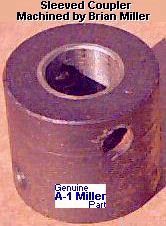 A rigid tubular rear driveshaft
coupler with a worn center can be repaired by boring out the center and
installing a press-fit steel sleeve. Then ream the sleeve to .626" for a
slip-fit on the driveshaft. Then the holes
for the coiled/spiral pins can be drilled. The boring and reaming process
should be performed on a milling machine with a self-centering 3-jaw super
spacer or in a
metal lathe with a self-centering 3-jaw chuck.
(IMPORTANT: If you don't feel comfortable using
a metal lathe, please consult a professional and experienced machinist with
a lathe.)
A rigid tubular rear driveshaft
coupler with a worn center can be repaired by boring out the center and
installing a press-fit steel sleeve. Then ream the sleeve to .626" for a
slip-fit on the driveshaft. Then the holes
for the coiled/spiral pins can be drilled. The boring and reaming process
should be performed on a milling machine with a self-centering 3-jaw super
spacer or in a
metal lathe with a self-centering 3-jaw chuck.
(IMPORTANT: If you don't feel comfortable using
a metal lathe, please consult a professional and experienced machinist with
a lathe.)
 Installing a coiled/spiral pin
in the rear of the driveshaft to connect the coupler to the input shaft on
the transaxle of a Cub Cadet garden tractor can be very difficult. To make
it much easier, simply use a 1/4" grade 8 bolt instead. For strength, the
shank (unthreaded part) of the bolt needs to have full contact with the coupler
and driveshaft. And as long as the driveshaft is in correct alignment with
the centerline of the crankshaft and transaxle input shaft, with the
coiled/spiral pin holes in-line with each other, and not offset 90°,
at around 4,000 RPM, this should not cause the driveshaft to "shake around"
or vibrate whatsoever. At high RPM or at
wide
open throttle, a center support pillow
block bearing and brace should be used midway on the driveshaft.
Installing a coiled/spiral pin
in the rear of the driveshaft to connect the coupler to the input shaft on
the transaxle of a Cub Cadet garden tractor can be very difficult. To make
it much easier, simply use a 1/4" grade 8 bolt instead. For strength, the
shank (unthreaded part) of the bolt needs to have full contact with the coupler
and driveshaft. And as long as the driveshaft is in correct alignment with
the centerline of the crankshaft and transaxle input shaft, with the
coiled/spiral pin holes in-line with each other, and not offset 90°,
at around 4,000 RPM, this should not cause the driveshaft to "shake around"
or vibrate whatsoever. At high RPM or at
wide
open throttle, a center support pillow
block bearing and brace should be used midway on the driveshaft.
For pulling applications, rubber motor mounts (and the flexible coupler at the rear of the driveshaft) absorbs valuable horsepower, which must be transferred to the rear tires for full power to the track. The rubber motor mounts will also cause the engine to vibrate excessively at high RPM or at wide open throttle. Plus, with normal use of the tractor, rubber motor mounts could cause the flexible 3-pin drive plate and/or the driveshaft to eventually break. If a tractor that have rubber motor mounts and a flexible coupler is going to be used for competition pulling, definitely install some metal motor mounts.
First of all, when using a milling machine, use a spotting drill bit, or use a center punch or transfer punch to locate exactly where the hole needs to be drilled to prevent the drill bit from "skating" on the surface. This will position and guide the drill bit to bore EXACTLY where the hole needs to be drilled. And due to the natural expansion of a roll, coiled or coiled/spiral pin, ALWAYS drill the hole with a drill bit that's one size smaller than the actual size for the roll, coiled or coiled/spiral pin's size, to allow for sufficient compression of the pin when installed in the hole. For example: for a 1/4" roll, coiled or coiled/spiral pin, initially drill the hole with a 15/64" drill bit (one size smaller than the 1/4" drill bit), then finish enlarging the same hole with a 1/4" drill bit. Doing this will guarantee the hole will be EXACTLY 1/4" in diameter. If the hole is initially drilled with just the 1/4" bit, chances are, this will cause the hole to be wallowed out, making it too big for the 1/4" roll, coiled or coiled/spiral pin. [Return to Previous Section, Paragraph or Website]
Advertisement: (Prices are subject to change without notice.)
| Click here to contact A-1 Miller's Performance Enterprises to place an order, send your parts for repairing, and/or for FREE professional and honest technical customer service assistance and support and payment options. Please contact A-1 Miller's if you need a part or parts, or service(s) performed that's not listed or mentioned in this website. | |||
Solid Motor Mount Kit for Cub
Cadet "Quiet Line" Garden Tractors. Replace OEM Rubber ISO-Mounts with a
Set of Solid Motor Mounts to Prevent Repeated and Costly Damage to the Clutch
Components! An original, ingenious, innovative concept invention
by Brian Miller, because I was the one who originally thought of, promoted
and advertised the use of this product. Please accept no copycat products
of this kind. (But I do appreciate them acknowledging my ingenuity and
intelligence.)  [Top
of Page] [Top
of Page]
Details include:
|
|||
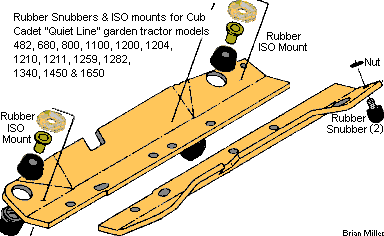   Cub
Cadet "Quiet Line" Garden Tractor Engine Mounting Rubber Snubbers/Bumpers
and Rubber ISO-Mounts. Fits Cub Cadet "Quiet Line" garden tractor
models 482, 800, 1000, 1100, 1200, 1204, 1210, 1211, 1250, 1282, 1340, 1450
and 1650. All these models have a rubber ISO-mounted
engine to reduce overall tractor vibration for operator comfort. The rubber
ISO-mounts can be adapted for use on various other makes and models of small
engine equipment to reduce engine vibration throughout the frame.
[Return to Previous Section, Paragraph
or Website] Cub
Cadet "Quiet Line" Garden Tractor Engine Mounting Rubber Snubbers/Bumpers
and Rubber ISO-Mounts. Fits Cub Cadet "Quiet Line" garden tractor
models 482, 800, 1000, 1100, 1200, 1204, 1210, 1211, 1250, 1282, 1340, 1450
and 1650. All these models have a rubber ISO-mounted
engine to reduce overall tractor vibration for operator comfort. The rubber
ISO-mounts can be adapted for use on various other makes and models of small
engine equipment to reduce engine vibration throughout the frame.
[Return to Previous Section, Paragraph
or Website]
|
|||
 OEM-Thickness
Bronze Pilot Bushing. Fits all pre-1981 gear drive IH-built Cub Cadet garden
tractor models 70, 71, 72, 73, 86, 100, 102, 104, 106, 108, 122, 124, 126
and 128, except "Quiet Line" models. This is also the replacement bushing
for the IH Cub Cadet "Original" garden tractor pulley/clutch disc. Dimensions:
5/8" I.D. x 7/8" O.D. x 3/4" length. IMPORTANT: To prevent the replacement
pilot bushing from premature wear, both OEM pressure plates should be trued-up
in a
metal lathe (with a self-centering 3-jaw chuck) so they'll
be perfectly round (to reduce premature pilot bushing wear, and resurfaced
until perfectly flat for better clutch adhesion), and before reinstalling
the driveshaft/clutch assembly in the tractor, apply automotive grease inside
the pilot bushing and/or on the front of the driveshaft. Because if the bushing
is dry, chances are, the driveshaft can bind up in the bushing, the clutch
may not release, and cause severe wear to both the bushing and driveshaft. OEM-Thickness
Bronze Pilot Bushing. Fits all pre-1981 gear drive IH-built Cub Cadet garden
tractor models 70, 71, 72, 73, 86, 100, 102, 104, 106, 108, 122, 124, 126
and 128, except "Quiet Line" models. This is also the replacement bushing
for the IH Cub Cadet "Original" garden tractor pulley/clutch disc. Dimensions:
5/8" I.D. x 7/8" O.D. x 3/4" length. IMPORTANT: To prevent the replacement
pilot bushing from premature wear, both OEM pressure plates should be trued-up
in a
metal lathe (with a self-centering 3-jaw chuck) so they'll
be perfectly round (to reduce premature pilot bushing wear, and resurfaced
until perfectly flat for better clutch adhesion), and before reinstalling
the driveshaft/clutch assembly in the tractor, apply automotive grease inside
the pilot bushing and/or on the front of the driveshaft. Because if the bushing
is dry, chances are, the driveshaft can bind up in the bushing, the clutch
may not release, and cause severe wear to both the bushing and driveshaft.
|
|||
 Thin-Wall Bronze
Pilot Bushing Insert for installing inside a worn OEM bronze pilot bushing
in all pre-1981 gear drive IH Cub Cadet garden tractor models 70, 71, 72,
73, 86, 100, 102, 104, 106, 108, 122, 124, 126 and 128, except "Quiet Line"
models. Can also be used inside the OEM bushing in the IH Cub Cadet "Original"
garden tractor pulley/clutch disc. Dimensions: 5/8" I.D. x 3/4" O.D. x 3/4"
length. NOTE: Worn OEM bushing must be precision center-bored to .750"
in a
metal lathe (with a self-centering 3-jaw chuck) so this
bushing will have a press fit. IMPORTANT: To prevent the replacement pilot
bushing from premature wear, both OEM pressure plates should be resurfaced
and trued-up in a metal lathe (with a self-centering 3-jaw chuck) so they'll
be perfectly round (to reduce premature pilot bushing wear, and resurfaced
until perfectly flat for better clutch adhesion), and before reinstalling
the driveshaft/clutch assembly in the tractor, apply automotive grease inside
the pilot bushing and/or on the front of the driveshaft. Because if the bushing
is dry, chances are, the driveshaft can bind up in the bushing, the clutch
may not release, and cause severe wear to both the bushing and driveshaft.
$3.00 each, plus shipping & handling. Thin-Wall Bronze
Pilot Bushing Insert for installing inside a worn OEM bronze pilot bushing
in all pre-1981 gear drive IH Cub Cadet garden tractor models 70, 71, 72,
73, 86, 100, 102, 104, 106, 108, 122, 124, 126 and 128, except "Quiet Line"
models. Can also be used inside the OEM bushing in the IH Cub Cadet "Original"
garden tractor pulley/clutch disc. Dimensions: 5/8" I.D. x 3/4" O.D. x 3/4"
length. NOTE: Worn OEM bushing must be precision center-bored to .750"
in a
metal lathe (with a self-centering 3-jaw chuck) so this
bushing will have a press fit. IMPORTANT: To prevent the replacement pilot
bushing from premature wear, both OEM pressure plates should be resurfaced
and trued-up in a metal lathe (with a self-centering 3-jaw chuck) so they'll
be perfectly round (to reduce premature pilot bushing wear, and resurfaced
until perfectly flat for better clutch adhesion), and before reinstalling
the driveshaft/clutch assembly in the tractor, apply automotive grease inside
the pilot bushing and/or on the front of the driveshaft. Because if the bushing
is dry, chances are, the driveshaft can bind up in the bushing, the clutch
may not release, and cause severe wear to both the bushing and driveshaft.
$3.00 each, plus shipping & handling. |
|||
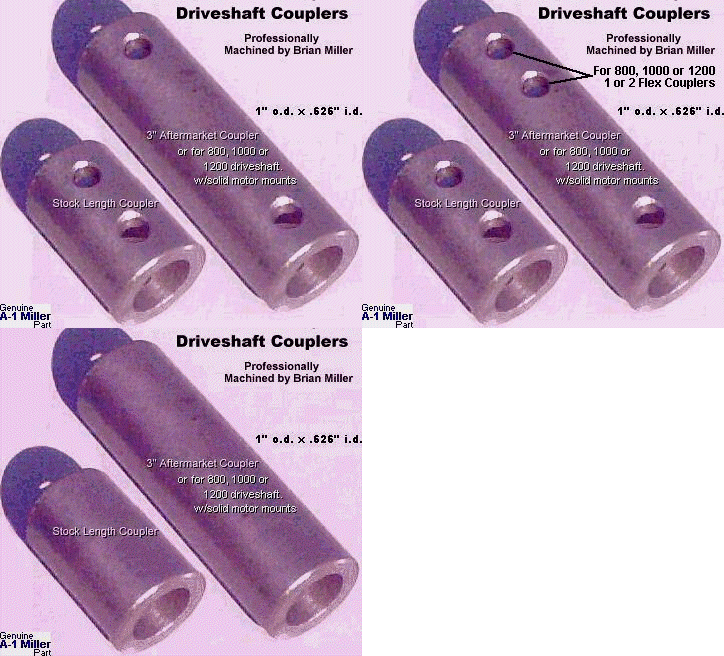  Tubular Driveshaft Couplers. Available in OEM stock
length, 1" longer than stock length (to lessen driveshaft wobble) or 3" rigid
tubular carbon steel driveshaft one-piece rigid tubular coupler. For a
custom-length coupler, exact locations where the coiled/spiral pin holes
need to be drilled are required. Custom-length rigid tubular driveshaft couplers,
up to 6" length are available. To find the location of the coiled/spiral
pin holes, install the driveshaft in the tractor with the engine fastened
to the frame with a couple of bolts, make sure the clutch disc is midway
on the drive pins, then measure precisely from the rear coiled/spiral pin
hole on the driveshaft to the coiled/spiral pin hole in the input shaft in
the transaxle, then add 3/4" for the overall length of the coupler. And one-piece
couplers to replace rubber flex coupler disc and coupler arms on AQS (Quiet
Line) Cub Cadet garden tractor models 800, 1000, 1050 and 1200 when using
solid motor mounts. The 800, 1000 and 1200
coupler will come with two roll pin holes for single or double rubber flex
coupler(s). NOTE: The 3" aftermarket coupler is
used only for competition pulling tractors with a shortened driveshaft so
the input shaft/pinion drive gear can be changed to vary the ground speed
of the tractor. And when ordering, please specify model of Cub Cadet garden
tractor, overall length and coiled/spiral pin hole locations. Tubular Driveshaft Couplers. Available in OEM stock
length, 1" longer than stock length (to lessen driveshaft wobble) or 3" rigid
tubular carbon steel driveshaft one-piece rigid tubular coupler. For a
custom-length coupler, exact locations where the coiled/spiral pin holes
need to be drilled are required. Custom-length rigid tubular driveshaft couplers,
up to 6" length are available. To find the location of the coiled/spiral
pin holes, install the driveshaft in the tractor with the engine fastened
to the frame with a couple of bolts, make sure the clutch disc is midway
on the drive pins, then measure precisely from the rear coiled/spiral pin
hole on the driveshaft to the coiled/spiral pin hole in the input shaft in
the transaxle, then add 3/4" for the overall length of the coupler. And one-piece
couplers to replace rubber flex coupler disc and coupler arms on AQS (Quiet
Line) Cub Cadet garden tractor models 800, 1000, 1050 and 1200 when using
solid motor mounts. The 800, 1000 and 1200
coupler will come with two roll pin holes for single or double rubber flex
coupler(s). NOTE: The 3" aftermarket coupler is
used only for competition pulling tractors with a shortened driveshaft so
the input shaft/pinion drive gear can be changed to vary the ground speed
of the tractor. And when ordering, please specify model of Cub Cadet garden
tractor, overall length and coiled/spiral pin hole locations.
|
|||
| IMPORTANT: To prevent either replacement pilot bushing listed below from wearing prematurely, for clutch drive tractors, both pressure plates should be trued-up and resurfaced in a metal lathe (with a self-centering 3-jaw chuck) so they'll be perfectly round and flat (for better clutch adhesion). And before reinstalling the driveshaft/clutch assembly in the tractor, apply automotive chassis or wheel bearing grease inside the pilot bushing and/or on the front of the driveshaft. Because if the bushing or driveshaft is dry, chances are, the driveshaft can bind up in the bushing, the clutch may not release, and cause severe wear to both the bushing and driveshaft. | |||
 Replacement
Self-Aligning Spherical Bronze Bushing w/Outer Steel Race/Retainer. Fits
pilot bushing retainers listed below and input shaft coupler arm further
below in Cub Cadet "Quiet Line" rubber
ISO-mounted engine garden tractor models 482, 580, 582, 582 Special,
680, 682, 782, 782D, 784, 800, 882, 982, 984, 1000, 1050, 1200, 1204, 1210,
1211, 1250, 1282, 1450, 1512, 1541, 1572, 1604, 1606, 1650, 1710, 1711, 1712,
1772, 1806, 1810, 1811, 1860, 1872, 1912, 1914 and 2072. Install with hammer
and socket. OEM Cub Cadet part # 941-3004. $52.00 each, plus shipping
& handling. Replacement
Self-Aligning Spherical Bronze Bushing w/Outer Steel Race/Retainer. Fits
pilot bushing retainers listed below and input shaft coupler arm further
below in Cub Cadet "Quiet Line" rubber
ISO-mounted engine garden tractor models 482, 580, 582, 582 Special,
680, 682, 782, 782D, 784, 800, 882, 982, 984, 1000, 1050, 1200, 1204, 1210,
1211, 1250, 1282, 1450, 1512, 1541, 1572, 1604, 1606, 1650, 1710, 1711, 1712,
1772, 1806, 1810, 1811, 1860, 1872, 1912, 1914 and 2072. Install with hammer
and socket. OEM Cub Cadet part # 941-3004. $52.00 each, plus shipping
& handling. |
 Round Retainer
with Pressed-In Self-Aligning Spherical Pilot Bushing. Fits Cub Cadet "Quiet
Line" rubber ISO-mounted engine garden tractor
models 800, 1000, 1200, 1250, 1450 and 1650. OEM Cub Cadet IH-126205-C2.
$141.00 each, plus shipping & handling. Round Retainer
with Pressed-In Self-Aligning Spherical Pilot Bushing. Fits Cub Cadet "Quiet
Line" rubber ISO-mounted engine garden tractor
models 800, 1000, 1200, 1250, 1450 and 1650. OEM Cub Cadet IH-126205-C2.
$141.00 each, plus shipping & handling. |
||
 Rectangular Flange with
Pressed-In Self-Aligning Spherical Bronze Pilot Bushing. Fits Cub Cadet "Quiet
Line" rubber ISO-mounted engine garden tractor
models 680, 682, 782, 784, 1204, 1210, 1211, 1250, 1282, 1450, 1541, 1650,
1710, 1711, 1712, 1810, 1811, 1812, 1860, 1872 and 2072. OEM Cub Cadet part
# 903-0204. $33.65 each, plus shipping & handling. Rectangular Flange with
Pressed-In Self-Aligning Spherical Bronze Pilot Bushing. Fits Cub Cadet "Quiet
Line" rubber ISO-mounted engine garden tractor
models 680, 682, 782, 784, 1204, 1210, 1211, 1250, 1282, 1450, 1541, 1650,
1710, 1711, 1712, 1810, 1811, 1812, 1860, 1872 and 2072. OEM Cub Cadet part
# 903-0204. $33.65 each, plus shipping & handling. |
 Rectangular
Flange with Pressed-In Self-Aligning Spherical Bronze Pilot Bushing. Fits
Cub Cadet "Quiet Line" rubber ISO-mounted
engine garden tractor models 982, 984, 986, 1912 and 1914. Discontinued Cub
Cadet part # 703-0231. $45.00 each with new bushing, plus shipping
& handling. (When available or in stock.) Rectangular
Flange with Pressed-In Self-Aligning Spherical Bronze Pilot Bushing. Fits
Cub Cadet "Quiet Line" rubber ISO-mounted
engine garden tractor models 982, 984, 986, 1912 and 1914. Discontinued Cub
Cadet part # 703-0231. $45.00 each with new bushing, plus shipping
& handling. (When available or in stock.) |
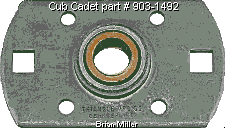 Rectangular Flange with
Pressed-In Self-Aligning Spherical Bronze Pilot Bushing. Fits Cub Cadet "Quiet
Line" rubber ISO-mounted engine garden tractor
models Fits models 1050, 1535 and 1806. OEM Cub Cadet part # 903-1492.
$50.20 each, plus shipping & handling. Rectangular Flange with
Pressed-In Self-Aligning Spherical Bronze Pilot Bushing. Fits Cub Cadet "Quiet
Line" rubber ISO-mounted engine garden tractor
models Fits models 1050, 1535 and 1806. OEM Cub Cadet part # 903-1492.
$50.20 each, plus shipping & handling. |
|
 Transaxle
Input Shaft Coupler Arm with 5/8" Hole and 25/64" Alignment Hole. Fits
Cub Cadet "Original" garden tractor and Cub Cadet garden tractor models 105,
107, 109, 123, 125, 127, 129, 147, 149 and 169. NOTE: This particular
part goes on the input shaft of the transaxle and not on the driveshaft.
The 5/8" hole goes on the input shaft, and the 3/8" stub shaft on driveshaft
fits in the 3/8" alignment hole. Can also be used on a custom-built steering
shaft setup of a mini-rod pulling tractor as a type of U-joint with a maximum
35º rotational angle with either flex coupler disc listed below. Dimensions:
25/64" bolt holes spaced 3" apart x 25/64" center pilot hole (for support
end of driveshaft) x 5/8" center hole.
[Return To Previous Section, Paragraph
or Website] Transaxle
Input Shaft Coupler Arm with 5/8" Hole and 25/64" Alignment Hole. Fits
Cub Cadet "Original" garden tractor and Cub Cadet garden tractor models 105,
107, 109, 123, 125, 127, 129, 147, 149 and 169. NOTE: This particular
part goes on the input shaft of the transaxle and not on the driveshaft.
The 5/8" hole goes on the input shaft, and the 3/8" stub shaft on driveshaft
fits in the 3/8" alignment hole. Can also be used on a custom-built steering
shaft setup of a mini-rod pulling tractor as a type of U-joint with a maximum
35º rotational angle with either flex coupler disc listed below. Dimensions:
25/64" bolt holes spaced 3" apart x 25/64" center pilot hole (for support
end of driveshaft) x 5/8" center hole.
[Return To Previous Section, Paragraph
or Website]
|
|||
  Driveshaft (or Input Shaft) Coupler Arm
with 5/8" Straight-Through Hole. Fits Cub Cadet garden tractor models
482, 580, 582, 680, 682, 782, 782D, 784, 782D, 800, 882, 1000, 1050, 1100,
1200, 1204, 1210, 1211, 1250, 1282, 1450, 1512, 1541, 1604, 1650, 1710, 1711,
1712, 1806, 1810, 1811, 1812 and 1860. NOTE: This particular part goes
on the driveshaft and not on the input shaft of the transaxle. Additional
Note: This part can be substituted for the coupler arm listed above for Cub
Cadet "Original" garden tractor and Cub Cadet garden tractor models 105,
107, 109, 123, 125, 127, 129, 147, 149 and 169 with a new unmachined driveshaft
(with a 5/8" stub shaft instead of OEM 3/8" stub shaft) when used on the
transaxle input shaft with end of driveshaft at 5/8" for better stability
and less wear to stub shaft and coupler arm. (A-1 Miller's improved design.)
Can also be used on a custom-built steering shaft setup of a mini-rod
pulling tractor as a type of U-joint with a maximum 35º rotational angle
with either rubber flex coupler disc listed below. Dimensions: 25/64" bolt
holes spaced 3" apart x 5/8" center through-hole.
[Return To Previous Section, Paragraph
or Website] Driveshaft (or Input Shaft) Coupler Arm
with 5/8" Straight-Through Hole. Fits Cub Cadet garden tractor models
482, 580, 582, 680, 682, 782, 782D, 784, 782D, 800, 882, 1000, 1050, 1100,
1200, 1204, 1210, 1211, 1250, 1282, 1450, 1512, 1541, 1604, 1650, 1710, 1711,
1712, 1806, 1810, 1811, 1812 and 1860. NOTE: This particular part goes
on the driveshaft and not on the input shaft of the transaxle. Additional
Note: This part can be substituted for the coupler arm listed above for Cub
Cadet "Original" garden tractor and Cub Cadet garden tractor models 105,
107, 109, 123, 125, 127, 129, 147, 149 and 169 with a new unmachined driveshaft
(with a 5/8" stub shaft instead of OEM 3/8" stub shaft) when used on the
transaxle input shaft with end of driveshaft at 5/8" for better stability
and less wear to stub shaft and coupler arm. (A-1 Miller's improved design.)
Can also be used on a custom-built steering shaft setup of a mini-rod
pulling tractor as a type of U-joint with a maximum 35º rotational angle
with either rubber flex coupler disc listed below. Dimensions: 25/64" bolt
holes spaced 3" apart x 5/8" center through-hole.
[Return To Previous Section, Paragraph
or Website]
|
|||
 Transaxle Input Shaft Coupler Arm with Self-Aligning
Spherical Bronze Swivel Bushing and Outer Steel Race/Retainer. Each fits
Cub Cadet garden tractor models 482, 580, 582, 682, 782, 782D, 800, 882,
1000, 1050, 1100, 1200, 1204, 1210, 1211, 1250, 1282, 1450, 1512, 1541, 1604,
1650, 1710, 1711, 1712, 1806, 1810, 1811, 1812 and 1860. Dimensions: bolt
holes spaced 3" apart x 5/8" center through-hole. NOTE: This particular
part goes on the input shaft of the transaxle and not on the driveshaft. Transaxle Input Shaft Coupler Arm with Self-Aligning
Spherical Bronze Swivel Bushing and Outer Steel Race/Retainer. Each fits
Cub Cadet garden tractor models 482, 580, 582, 682, 782, 782D, 800, 882,
1000, 1050, 1100, 1200, 1204, 1210, 1211, 1250, 1282, 1450, 1512, 1541, 1604,
1650, 1710, 1711, 1712, 1806, 1810, 1811, 1812 and 1860. Dimensions: bolt
holes spaced 3" apart x 5/8" center through-hole. NOTE: This particular
part goes on the input shaft of the transaxle and not on the driveshaft.
|
|||
5/8" Steel Ball. Fits IH-built Cub Cadet garden tractor models
800, 1000 and 1200. This ball is located at the end of the driveshaft
and inside the rear flex arm coupler (with the bronze swivel bushing; listed
above) and sometimes gets lost when removing the clutch assembly/driveshaft
from the tractor. It allows the driveshaft to "move side to side" with the
engine (that's mounted on rubber mounts). If it's left out, the clutch
assembly/driveshaft will move further back 5/8" when the clutch pedal is
depressed, and the clutch disc will not release and operate correctly. The
MTD-built models have no steel ball. The end of the [5/8" longer] driveshaft
is pointed, which fits in the pilot hole of the input shaft in the
transaxle.
|
|||
| Reinforced
Rubber Driveshaft Flex Coupler Disc. Designed specifically for Cub Cadet
"Quiet Line" garden tractor models 482, 580, 582, 582 Special, 682, 782,
782D, 800, 882, 982, 984, 986, 1000, 1050, 1100, 1200, 1204, 1210, 1211,
1250, 1282, 1450, 1512, 1541, 1604, 1606, 1650, 1710, 1711, 1712, 1806, 1810,
1811, 1812, 1860, 1872, 1912, 1914 and 2072. Can also be used on the IH Cub
Cadet "Original" garden tractor. All IH-built Cub Cadet models require one
flex coupler disc at each end of driveshaft, and all MTD-built Cub Cadet
models use two flex coupler discs at each end of driveshaft. Very tough,
reinforced rubber/weaved composite material. Allows for out-of-alignment
rotation of driveshaft in rubber ISO-mounted
engine tractors to prevent damage to the clutch parts or hydrostatic pump.
Has larger center hole than coupler listed above to clear housing in coupler
arm with self-aligning spherical bushing. Can be substituted for flex coupler
listed above. Can also be used in a steering shaft setup of a custom-built
mini-rod pulling tractor as a type of U-joint with a maximum 35º rotational
angle with coupler arm(s) listed above. 13/32" bolt holes spaced 3" apart.
OEM Cub Cadet part # 722-3000. $29.00 each, plus shipping & handling.
|
|||
| The OEM Cub Cadet Hydrostatic Drive Garden Tractor Hub (shown
to the left in the photo below; Cub Cadet part # IH-394034-R32) in IH Cub
Cadet garden tractor models 105, 107, 109, 123, 125, 127, 129, 147, 149 and
169 is notorious for the slots becoming severely worn due to a slight
misalignment of the engine with the driveshaft. To fix this, replace this
hub with the parts shown to the right -> in the photo below. Because these
parts will last a lot longer, and they'll produce no noise. Modification
to the front of the driveshaft will need to be made.
Click here to contact A-1 Miller's
Performance Enterprises to place an order, send your parts for repairing,
and/or for FREE professional and honest technical customer service assistance
and support and payment options. If you need a part or parts
that's not listed in this website, please contact A-1 Miller's and we'll
see if we can get it at a reasonable price.
|
|||
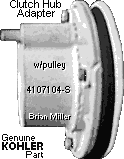
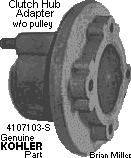 The main cause of breakage of the OEM Cub Cadet garden tractor
aluminum hub adapter on competition pulling engines that run at wide open
throttle is using out-of-balance OEM pressure plates and OEM 3-pin clutch
drive plate, and/or not installing the large flat washer under the nut or
bolt (as described below Ê). So as long
as the drive plate and pressure plates are trued-up in a
metal lathe (with a self-centering 3-jaw chuck) so they'll
be perfectly round (to reduce premature pilot bushing wear, and resurfaced
until perfectly flat for better clutch adhesion) to remove the run-out or
wobble so they'll be precision balanced, this hub have been known to hold
up very well even in a highly modified competition pulling tractor as
long as the original 1/4" thick x no less than 1-1/4" O.D. flat washer is
installed under the flywheel nut or bolt with hardened 1/4" bolts w/split
lock washers to securely fasten the drive plate to the hub. Otherwise,
it's pretty tough.
The main cause of breakage of the OEM Cub Cadet garden tractor
aluminum hub adapter on competition pulling engines that run at wide open
throttle is using out-of-balance OEM pressure plates and OEM 3-pin clutch
drive plate, and/or not installing the large flat washer under the nut or
bolt (as described below Ê). So as long
as the drive plate and pressure plates are trued-up in a
metal lathe (with a self-centering 3-jaw chuck) so they'll
be perfectly round (to reduce premature pilot bushing wear, and resurfaced
until perfectly flat for better clutch adhesion) to remove the run-out or
wobble so they'll be precision balanced, this hub have been known to hold
up very well even in a highly modified competition pulling tractor as
long as the original 1/4" thick x no less than 1-1/4" O.D. flat washer is
installed under the flywheel nut or bolt with hardened 1/4" bolts w/split
lock washers to securely fasten the drive plate to the hub. Otherwise,
it's pretty tough.
Separate the Brake and Clutch Operations - (This have been done by many professional pullers in the past.)
Cub Cadet garden tractors that have the brakes integrated with the clutch/brake pedal, when applying the brakes on a competition pulling tractor that have an extremely stiff clutch pressure spring (on the driveshaft), great effort is required (strong leg muscles) to overcome and compress the clutch spring before the brakes can be safely applied. When rolling the tractor off a trailer, this also requires even greater effort to depress the clutch/brake pedal to apply the brakes especially by hand (and arm muscles). What can be done to change this is separate the brake(s) and the clutch operations by disconnecting the brake linkage from the clutch/brake pedal cross shaft, and fabricate a long upright lever (with an adjustable linkage) on the right side of the steering column support pedestal which can be easily and effortlessly pulled back (rearward) by hand to apply the brakes. The clutch/brake pedal will then become just a "clutch pedal," and the lever will be the "brake lever." This would make it much safer and easier to fully stop or slow the tractor down a steep hill or when unloading the tractor down the ramp(s) of a utility trailer or platform work table than on the floor or ground. Also, a "parking brake" lock mechanism can be installed on the brake lever-to-tractor frame to securely lock the brakes in position to prevent the tractor from rolling or coasting when the tractor is out of gear and the engine running.
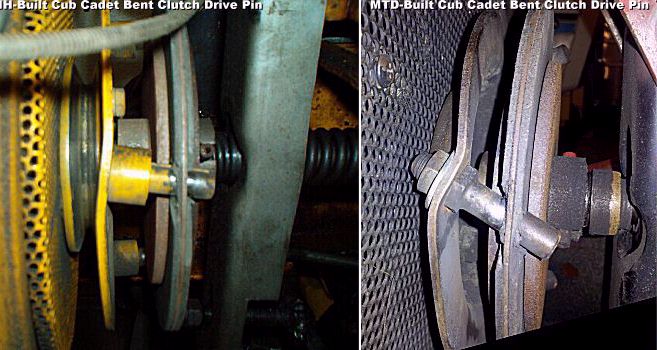 If an OEM 3-pin clutch drive
plate is bent next to the drive studs (MTD) or coiled/spiral pin collars
(IH), to fix this:
If an OEM 3-pin clutch drive
plate is bent next to the drive studs (MTD) or coiled/spiral pin collars
(IH), to fix this:
If the bronze pilot bushing in a drive plate is excessively worn, this means that the OEM pressure plates are badly out of balance and/or there was no grease applied to the bushing or on the driveshaft before installation of the clutch assembly in the tractor. In either case, resurface the pressure plates until they're perfectly flat and true-up the edge to prevent wobble in a metal lathe. IMPORTANT: To ensure true flatness when resurfacing pressure plates, use a lathe that's in good condition with very little wear on the ways! (IMPORTANT: If you don't feel comfortable using a metal lathe, please consult a professional and experienced machinist with a lathe.)
Advertisement: (Prices are subject to change without notice.)
| Click here to contact A-1 Miller's Performance Enterprises to place an order, send your parts for repairing, and/or for FREE professional and honest technical customer service assistance and support and payment options. Please contact A-1 Miller's if you need a part or parts, or service(s) performed that's not listed or mentioned in this website. |
 Extra Thick Flywheel / Aluminum
Hub Adapter Retaining Washers. A must to secure flywheel and prevent OEM
Cub Cadet or billet aluminum hub adapter breakage. Each made of steel and
measures approximately 1/4" thick x 1-1/4" O.D. Extra Thick Flywheel / Aluminum
Hub Adapter Retaining Washers. A must to secure flywheel and prevent OEM
Cub Cadet or billet aluminum hub adapter breakage. Each made of steel and
measures approximately 1/4" thick x 1-1/4" O.D.
|
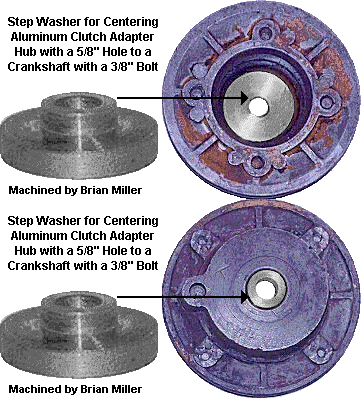 Adapter Step Washer. Use
this part to center OEM cast aluminum or billet hub adapter with the 5/8"
hole to a crankshaft with a 3/8" bolt on later model Kohler K-series and
all Magnum engines. A must to prevent severe wobble/vibration and prevent
hub and/or driveshaft/clutch breakage. Dimensions: 3/8" I.D. x 5/8" O.D.
step x approximately 1-1/4" overall O.D. x 1/2" overall height. Professionally
machined by A-1 Miller's. Adapter Step Washer. Use
this part to center OEM cast aluminum or billet hub adapter with the 5/8"
hole to a crankshaft with a 3/8" bolt on later model Kohler K-series and
all Magnum engines. A must to prevent severe wobble/vibration and prevent
hub and/or driveshaft/clutch breakage. Dimensions: 3/8" I.D. x 5/8" O.D.
step x approximately 1-1/4" overall O.D. x 1/2" overall height. Professionally
machined by A-1 Miller's.
|
Cub Cadet garden tractor
hub adapters with 5/8" center hole (early K-series), w/pulley, w/dowel pin.
Cub Cadet garden tractor hub adapters with 3/8" center hole (later K-series, all KT-series and Magnum), w/o pulley, w/dowel pin.
|
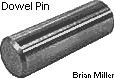 1/4" diameter x 3/4" length
hardened steel dowel pin for OEM and billet aluminum hub adapters. Secures
aluminum hub to flywheel to prevent slippage. Replaces Cub Cadet part # KH-X-56-7
and Kohler part # X-56-7. $1.50 each, plus shipping & handling. 1/4" diameter x 3/4" length
hardened steel dowel pin for OEM and billet aluminum hub adapters. Secures
aluminum hub to flywheel to prevent slippage. Replaces Cub Cadet part # KH-X-56-7
and Kohler part # X-56-7. $1.50 each, plus shipping & handling. |
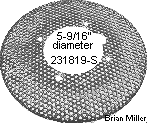 Flywheel grass/safety steel
screen for use in IH-built Cub Cadet garden tractors with Kohler engine models
K161 and K181. 5-9/16" diameter. Flywheel grass/safety steel
screen for use in IH-built Cub Cadet garden tractors with Kohler engine models
K161 and K181. 5-9/16" diameter.
|
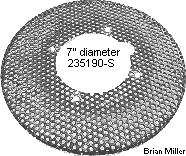 Flywheel grass/safety steel
screen for use in IH-built Cub Cadet garden tractors with Kohler engine models
K241 and K301. 7" diameter. Flywheel grass/safety steel
screen for use in IH-built Cub Cadet garden tractors with Kohler engine models
K241 and K301. 7" diameter.
|
It's Very Important to Resurface and True-Up Worn and Warped OEM Cub Cadet Pressure Plates! -
For any clutch disc to adhere or grip well and to prevent slippage, and to reduce premature pilot bushing wear, both OEM pressure plates should be resurfaced until they're perfectly flat in a metal lathe. (IMPORTANT: If you don't feel comfortable using a metal lathe, please consult a professional and experienced machinist with a lathe.) The outer edge should be trued-up in a metal lathe (with a self-centering 3-jaw chuck) so they'll be perfectly round (to reduce premature pilot bushing wear, and resurfaced until perfectly flat for better clutch adhesion), which can cause the pilot bushing to wear excessively. For a used clutch assembly, chances are, the composite clutch disc is worn to match the wear on the pressure plates. If the clutch disc is worn, but still reusable, it can be resurfaced in the lathe as well. For best clutch adhesion and to lessen the chance of slippage, the clutch-to-pressure plates surface contact areas must be flat against flat for 100% contact. Because new OEM Cub Cadet garden tractor pressure plates are made of stamped steel and are not machined whatsoever. This means they are not perfectly flat and they wobble from the factory. If used pressure plates have not been resurfaced before, then chances are, they'll still be thick enough after being resurfaced. Always remove the minimal amount of metal to retain maximum thickness so they will not warp when hot.
NOTE: Before reassembling the clutch assembly, apply a thin coat of automotive grease on the area of the driveshaft where the throw-out bearing and where the rear pressure plate slides back and forth. The grease will assure full clutch disengagement, lessen wear to the driveshaft, and it will prevent the rear pressure plate from sticking to the driveshaft due to rust if the tractor is stored in a damp environment. Also, while the rear pressure plate is off the driveshaft, to prevent it from binding on the 2nd coiled/spiral pin, which can prevent the clutch from disengaging, widen the slot slightly with a flat file or on the edge of the blade on a chopsaw. (Be sure to wear safety glasses!) And it'll be a good idea to drill a small hole near the center of the rear pressure plate to relieve the air that can get trapped between the pressure plates.
Advertisement: (Prices are subject to change without notice.)
| Click here to contact A-1 Miller's Performance Enterprises to place an order, send your parts for repairing, and/or for FREE professional and honest technical customer service assistance and support and payment options. Please contact A-1 Miller's if you need a part or parts, or service(s) performed that's not listed or mentioned in this website. |
| A-1 Miller's Professional Repair Services -
FACT: New OEM Cub Cadet garden tractor pressure plates from the factory are made of stamped steel (in a press) and NOT machined whatsoever in a metal lathe. This means the clutch contact area is not perfectly flat, which may cause the clutch disc to slip, and the outer edge is somewhat egg-shape, which causes them to wobble, have run-out and run out-of-balance, resulting in a worn pilot bushing and slight vibration throughout the entire tractor. New unmachined OEM pressure plates are exactly 3/16" thick. Therefore, minimal metal is removed to maintain maximum thickness and diameter for full clutch contact.
|
Warped OEM Cub Cadet garden tractor pressure plates will eventually allow a single or even double clutch setup to slip. They warp due to overheating when "slipping the clutch". When they get warped, they don't make full contact with the entire surface of the clutch disc. Whenever a new clutch disc is installed, rather if it's an OEM one or made of aluminum, the OEM pressure plates should always be trued-up in a metal lathe (with a self-centering 3-jaw chuck) so they'll be perfectly round and resurfaced until perfectly flat for better clutch adhesion. (IMPORTANT: If you don't feel comfortable using a metal lathe, please consult a professional and experienced machinist with a lathe.) New OEM pressure plates are stamped in a press and not machined in a lathe. This means they're not as flat or turn as true as ones that's been machined in a lathe. Therefore, if new or used OEM pressure plates are going to be used for pulling or heavy lawn and garden use, have the outer edge trued-up in a metal lathe (with a self-centering 3-jaw chuck) so they'll be perfectly round and resurfaced until perfectly flat for better clutch adhesion. Because new OEM pressure plates are made of stamped steel and are not machined whatsoever. This means they are not perfectly flat and they wobble from the factory. If used OEM pressure plates have not been resurfaced before, then chances are, they'll still be thick enough after being resurfaced. Always remove the minimal amount of metal to retain maximum thickness so they will not warp when hot.
The OEM Cub Cadet garden tractor pressure plates are 3/16" (.188") thick. On the average, approximately .005" of metal is removed from the face of each pressure plate after it have been resurfaced. Removing this much metal will not weaken the plates whatsoever, even when used with a very stout pressure spring.
With both OEM pressure plates properly resurfaced until perfectly flat, the OEM composite clutch, with 4-1/2" diameter OEM pressure plates, have a total disc to plate contact area of 17.7 square inches. The aluminum disc on the other hand (as described in this web site), have a total contact area of 29.8 square inches. You may look at this disc and ask, "where's the friction material?" Well, the aluminum itself is the friction material. The aluminum disc will adhere to (grip) steel a lot better than a composite clutch disc. Both of these type of clutch types, when used with a high pressure red (800± lb.) or yellow (1,150± lb.) spring, have been proven to hold very well in heavy pulling. IMPORTANT: To ensure true flatness when resurfacing pressure plates, use a lathe that's in good condition with very little wear on the ways!
Save the Hubs!
If the discs in your OEM pressure plates are heavily rusted, worn too thin or warped badly and resurfacing them in a lathe didn't do any good, instead of making two entirely new pressure plates, what could be done is remove the center hub from each disc with a hydraulic press and reuse the hubs to make two new pressure plates. This would save from having to fabricate a couple of new hubs.
If the center hole in the slotted hub of the rear [sliding] pressure plate is worn oblong (rare), the hole can be repaired by boring it true in a metal lathe, and a steel sleeve bushing will need to be pressed in and welded in to prevent it from coming loose, and the hole in the bushing will need to be center-bored to .626". The slot will need to be carefully ground out in the bushing to match the slot in the hub using the blade in an electric chop saw with a metal cut-off wheel. Finally, the face of the pressure plate can be trued-up in a metal lathe (with a self-centering 3-jaw chuck) so they'll be perfectly round and resurfaced until perfectly flat for better clutch adhesion. (Remember to wear safety glasses!) (IMPORTANT: If you don't feel comfortable using a metal lathe, please consult a professional and experienced machinist with a lathe.)
Use distilled white vinegar to remove rust from inside gas tanks, tools, bolts/nuts, clutch OEM pressure plates or virtually any steel or cast iron part: vinegar rust removal - YouTube.
If a single composite clutch disc slips in a stock competition pulling tractor, then what is required to prevent clutch slippage is to install a single piece of machined aluminum to serve as a clutch disc. With resurfaced OEM pressure plates and a high pressure red (800± lb.) or yellow (1,150± lb.) spring, aluminum should grip and hold up well when used in a stock competition pulling tractor. By the way, the OEM sandwiched steel composite clutch disc and an aluminum clutch disc weighs almost the same; about 10.6 ounces each.
The aluminum clutch disc works best for low RPM stock engines. If an aluminum clutch disc is used, there's no need to install three extra studs in the 3-pin drive plate (see below Ê ). But definitely have both OEM pressure plates resurfaced as described above È. Depending on the size of engine and weight of tractor, the aluminum clutch disc require a tougher driveshaft along with a high pressure red (800± lb.) or yellow (1,150± lb.) spring. And it'll be a good idea to install a center support bearing (center support pillow block bearing and brace) to prevent the driveshaft from wobbling at 4,000 RPM.
The
biggest mistake a puller can make when launching a tractor is letting the
clutch out all of a sudden with the engine revved up. So when using aluminum
as a clutch disc (or any metallic clutch material), and when the tractor
is hooked to the sled, always remember to "slip" the clutch upon take-off.
To do this, first rev up the engine (a lot), then slowly ease out on the
clutch pedal. Because an
aluminum clutch
disc may not "slip" at low RPM, and because aluminum
adheres to steel very well when under pressure, if the pedal is let out all
of a sudden with the engine revved up, and if the tires don't spin, something
could break or get damaged in the drive train or transaxle. The 5/8" zinc-plated
steel split lock washer that's placed between the pressure plates will aide
greatly in smooth clutch engagement/release and it lessens the possibility
of the clutch from "grabbing" upon take-off.
Advertisement: (Prices are subject to change without notice.)
| Click here to contact A-1 Miller's Performance Enterprises to place an order, send your parts for repairing, and/or for FREE professional and honest technical customer service assistance and support and payment options. Please contact A-1 Miller's if you need a part or parts, or service(s) performed that's not listed or mentioned in this website. | |
Cub Cadet Garden Tractor Clutch Discs - [Top of Page] [Return To Previous Section, Paragraph or Website]
6" Diameter High Quality Aftermarket Clutch Disc with drive holes spaced 5-1/8" apart. Fits all models of Cub Cadet clutch drive garden tractors. Made of very tough and long-lasting 100% composite fiber material to OEM clutch dimensions. Suitable for heavy duty yard and garden use or competition pulling. Replaces Cub Cadet part # 961-3002.
6" Diameter OEM Cub Cadet Clutch Disc with 3 drive holes spaced 5-1/8" apart. Must be used with a 3-pin/stud drive plate. Reinforced composite material with sandwiched steel. Listed for use in Cub Cadet garden tractor models 70, 71, 72, 73, 86, 100, 102, 104, 106, 108, 122, 124, 126, 128, 580, 582, 800, 1000, 1200, 1604 and 1606, but will also fit all models listed below. OEM Cub Cadet part # 961-3002. $96.10 each, plus shipping & handling. 6-1/2" Diameter OEM Cub Cadet Clutch Disc with 3 drive holes spaced 5-1/8" apart. Must be used with a 3-pin/stud drive plate. Reinforced composite material with sandwiched steel. Listed for use in Cub Cadet garden tractor models 1050, 1535 and 1806, but will also fit all models listed above. OEM Cub Cadet part # 961-3011. $93.75 each, plus shipping & handling.
|
|
 A-1 Miller's Original Machined Aluminum Clutch Disc Kit. This
is an alternate and direct replacement for the OEM-type
composite material clutch disc. Kit include 6-hole aluminum clutch
disc, 5/8" I.D. split lock washer (goes in center of aluminum disc and between
OEM pressure plates (provides smooth clutch engagement and guaranteed release)
and steel spacer (replaces OEM teasing spring). Precision machined of high
quality 6061 alloy medium-grade hardness aluminum. Drive holes are drilled
13/32" for minimum clutch disc noise/rattle and less chance of breakage to
the drive pins/studs. IMPORTANT: Use only with the
red (800± lb.) or yellow (1,150± lb.)
pressure spring and not the OEM spring to prevent clutch slippage. A
proven, ingenious and innovative concept by Brian Miller. Please do not accept
advertised copycat products of this kind. (But I do appreciate them acknowledging
my ingenuity and intelligence.)
A-1 Miller's Original Machined Aluminum Clutch Disc Kit. This
is an alternate and direct replacement for the OEM-type
composite material clutch disc. Kit include 6-hole aluminum clutch
disc, 5/8" I.D. split lock washer (goes in center of aluminum disc and between
OEM pressure plates (provides smooth clutch engagement and guaranteed release)
and steel spacer (replaces OEM teasing spring). Precision machined of high
quality 6061 alloy medium-grade hardness aluminum. Drive holes are drilled
13/32" for minimum clutch disc noise/rattle and less chance of breakage to
the drive pins/studs. IMPORTANT: Use only with the
red (800± lb.) or yellow (1,150± lb.)
pressure spring and not the OEM spring to prevent clutch slippage. A
proven, ingenious and innovative concept by Brian Miller. Please do not accept
advertised copycat products of this kind. (But I do appreciate them acknowledging
my ingenuity and intelligence.)
 IMPORTANT! It is highly recommended that both OEM
pressure plates be trued-up in a metal lathe (with a self-centering 3-jaw
chuck) so they'll be perfectly round and resurfaced until perfectly flat
for better clutch adhesion or severe clutch slippage will likely result!
Because new OEM pressure plates are made of stamped steel and are not machined
in a lathe whatsoever. If used OEM pressure plates have not been resurfaced
before, then chances are, they'll still be thick enough after being resurfaced.
Always remove the minimal amount of metal to retain maximum thickness so
they will not warp and become
convexed when hot.
CUB CADET
124 WORK PART 2 - YouTube
IMPORTANT! It is highly recommended that both OEM
pressure plates be trued-up in a metal lathe (with a self-centering 3-jaw
chuck) so they'll be perfectly round and resurfaced until perfectly flat
for better clutch adhesion or severe clutch slippage will likely result!
Because new OEM pressure plates are made of stamped steel and are not machined
in a lathe whatsoever. If used OEM pressure plates have not been resurfaced
before, then chances are, they'll still be thick enough after being resurfaced.
Always remove the minimal amount of metal to retain maximum thickness so
they will not warp and become
convexed when hot.
CUB CADET
124 WORK PART 2 - YouTube
Click here to contact A-1 Miller's Performance Enterprises to place an order, send your parts for repairing, and/or for FREE professional and honest technical customer service assistance and support and payment options. If you need a part or parts that's not listed in this website, please contact A-1 Miller's and we'll see if we can get it at a reasonable price. | [Top of Page] |
|
 Cub Cadet Garden
Tractor Clutch Disc Anti-Rattle Spring. Reduces annoying clutch disc rattle
on drive pins/studs and reduces wear to drive holes in clutch disc. Although
one spring may be sufficient to reduce clutch noise, it may be necessary
to install three springs (one for each pin/stud) for 100% reduced clutch
noise. Can be used on composite or aluminum clutch discs. NOTE: Recommended
for up to 4,000 RPM engines. Not for use on high RPM or wide open throttle
competition pulling tractors due to normal engine harmonic vibrations that
travels out into the clutch assembly, this can create the possibility of
the spring(s) becoming dislodged, which could become a hazardous airborne
projectile if clutch is not properly shielded 360º. So if possible,
install these springs with the coil between the clutch disc and drive plate,
opposite that is shown in the photo to the right, to prevent them from coming
off.
CUB CADET
124 WORK PART 2 - YouTube Cub Cadet Garden
Tractor Clutch Disc Anti-Rattle Spring. Reduces annoying clutch disc rattle
on drive pins/studs and reduces wear to drive holes in clutch disc. Although
one spring may be sufficient to reduce clutch noise, it may be necessary
to install three springs (one for each pin/stud) for 100% reduced clutch
noise. Can be used on composite or aluminum clutch discs. NOTE: Recommended
for up to 4,000 RPM engines. Not for use on high RPM or wide open throttle
competition pulling tractors due to normal engine harmonic vibrations that
travels out into the clutch assembly, this can create the possibility of
the spring(s) becoming dislodged, which could become a hazardous airborne
projectile if clutch is not properly shielded 360º. So if possible,
install these springs with the coil between the clutch disc and drive plate,
opposite that is shown in the photo to the right, to prevent them from coming
off.
CUB CADET
124 WORK PART 2 - YouTube
|
How to Get a composite or the Aluminum Clutch Disc to Engage Smoothly -
The OEM Cub Cadet garden tractor clutch cushion spring (as it is called in the early/narrow frame Cub Cadet garden tractors) or teasing spring (as it is called in the later models/wide and spread frame Cub Cadet garden tractors) goes between the rear pressure plate and clutch release/throw-out bearing. It's purpose is to allow the rear pressure plate to gently press against the clutch disc as the clutch is engaged without having a "jerky" clutch. When using an aluminum clutch disc, the teasing spring can be replaced with a steel spacer or a stack of small outside diameter flat washers (the ones that originally comes on Cub Cadet garden tractor driveshafts) and an ordinary, zinc-plated steel split lock washer. Install the lock washer between the pressure plates (dead center of the clutch disc) for a smoother clutch engagement. Clutch slippage may result if used with the OEM Cub Cadet garden tractor clutch pressure spring. Therefore, the aluminum clutch disc should be used with a stiffer-than-stock pressure spring, such as the high pressure red (800± lb.) or yellow (1,150± lb.) spring.
 For the narrow-frame Cub Cadet
garden tractors, the steel spacer needs to be 3/8" in length. (The teasing
spring is compressed to 3/8" when the clutch is fully engaged.) And for Cub
Cadet garden tractor models 86, 108, 128, 800, 1000, 1200 and 1535, the spacer
needs to 5/8" length or use the OEM protective cup/spacer (for the teasing)
that originally comes on the driveshaft, but leave the teasing spring out.
By the way - the small end of the protective cup/spacer goes against the
clutch release/throw-out bearing. If a too
long of a spacer or the protective spacer/cup is used in a narrow frame model,
the clutch release/throw-out bearing would
set too far back on the driveshaft and when the clutch/brake pedal is depressed,
the release lever will make contact with the
steering box and the clutch will not be able to release.
For the narrow-frame Cub Cadet
garden tractors, the steel spacer needs to be 3/8" in length. (The teasing
spring is compressed to 3/8" when the clutch is fully engaged.) And for Cub
Cadet garden tractor models 86, 108, 128, 800, 1000, 1200 and 1535, the spacer
needs to 5/8" length or use the OEM protective cup/spacer (for the teasing)
that originally comes on the driveshaft, but leave the teasing spring out.
By the way - the small end of the protective cup/spacer goes against the
clutch release/throw-out bearing. If a too
long of a spacer or the protective spacer/cup is used in a narrow frame model,
the clutch release/throw-out bearing would
set too far back on the driveshaft and when the clutch/brake pedal is depressed,
the release lever will make contact with the
steering box and the clutch will not be able to release.
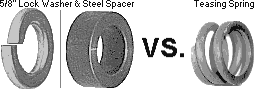 To prevent the teasing spring
from possibly breaking and to help the clutch(es) to engage more smoothly,
simply don't use the teasing spring. Instead, replace where the teasing spring
goes on the driveshaft with a piece of heavy wall round steel tubing that
measures 7/8" O.D. x 3/8" (narrow frame) or 5/8" (wide frame) long x 41/64"
I.D. Then install an ordinary zinc-plated 5/8" I.D. split lock washer between
the pressure plates, dead center of the clutch disc. Lock washers have a
spring-like action too, plus they'll last a lot longer than a teasing spring.
To prevent the teasing spring
from possibly breaking and to help the clutch(es) to engage more smoothly,
simply don't use the teasing spring. Instead, replace where the teasing spring
goes on the driveshaft with a piece of heavy wall round steel tubing that
measures 7/8" O.D. x 3/8" (narrow frame) or 5/8" (wide frame) long x 41/64"
I.D. Then install an ordinary zinc-plated 5/8" I.D. split lock washer between
the pressure plates, dead center of the clutch disc. Lock washers have a
spring-like action too, plus they'll last a lot longer than a teasing spring.
The lock washer does two things - it acts like a spring, which forces the pressure plates apart, it provides smooth clutch engagement and it'll help to prevent the possibility of the clutch disc from "grabbing" upon take-off. In addition, the spring-like action of the lock washer will expand the pressure plates when the clutch/brake pedal is fully depressed so they will release from the clutch disc. Doing this will guarantee that the clutch will engage smoothly and release every time. So when reassembling a clutch assembly, don't install the teasing spring. Instead, install the spacer and lock washer as described above È. You'll be glad you did.
Or for a bullet-proof teasing spring setup, and/or if the aluminum clutch disc doesn't engage smoothly, instead of using the 5/8" lock washer between the pressure plates and the teasing spring or a steel spacer, install a flat washer, the 5/8" lock washer, then another flat washer until they all total to about 3/8" or 5/8" in height with the lock washer fully uncompressed.
The correct order of installing Cub Cadet garden tractor clutch parts on the driveshaft is listed below Ê. NOTE: Before reassembling the clutch assembly, apply a thin coat of automotive grease on the area of the driveshaft where the throw-out bearing and where the rear pressure plate slides back and forth. The grease will assure full clutch disengagement, lessen wear to the driveshaft, and it will prevent the rear pressure plate from sticking to the driveshaft due to rust if the tractor is stored in a damp environment. Also, while the rear pressure plate is off the driveshaft, to prevent it from binding on the 2nd coiled/spiral pin, which can prevent the clutch from disengaging, widen the slot slightly with a flat file or on the edge of the blade on a chopsaw. (Be sure to wear safety glasses!) And it'll be a good idea to drill a small hole near the center of the rear pressure plate to relieve the air that can get trapped between the pressure plates.
| 1. Install 3rd coiled/spiral pin then the main
pressure spring. 2. Install clutch release/throw-out bearing (small end facing forward of tractor). 3. Install release lever . 4. Install protective spacer/cup (small end goes against clutch release/throw-out bearing). 5. Install teasing spring (for a fiber clutch disc) or steel spacer (for an aluminum clutch disc). |
6. Compress the pressure spring and install the 2nd coiled/spiral
pin. 7. Install pressure plate w/slotted hub. 8. Install zinc-plated steel split lock washer (use only with the aluminum clutch disc and very stiff pressure spring). 9. Install clutch disc. 10. Install pressure plate w/solid hub, then the 1st coiled/spiral pin. |
How to Replace a Broken Teasing Spring on a Cub Cadet Garden Tractor Driveshaft (with the driveshaft in the tractor) - (Added 8/28/17)
The Clutch Pedal Return Spring and Maintaining Proper Clutch Adjustment -

 Install the clutch pedal return spring to prevent from wearing
both the clutch release/throw-out bearing
and release lever. Don't just install a cotter
pin in place of it. A pedal return spring is a short, very stiff, expansion
spring with a hook on each end. The size is approximately 3/4" diameter x
2-1/8" in overall length. And do not "ride the clutch"! Take your foot
off the clutch pedal when the tractor is in motion.
Install the clutch pedal return spring to prevent from wearing
both the clutch release/throw-out bearing
and release lever. Don't just install a cotter
pin in place of it. A pedal return spring is a short, very stiff, expansion
spring with a hook on each end. The size is approximately 3/4" diameter x
2-1/8" in overall length. And do not "ride the clutch"! Take your foot
off the clutch pedal when the tractor is in motion.
The return spring connects from the hole in the end of the clutch adjustment/release rod to a hole in the cross member that's in the tractor's frame. Install one end of the spring in the linkage first, then install the other end in the cross member. NOTE: It may be difficult to get the end of the spring in the hole because of the tension, but it can be done and it MUST be done. (I do it all the time with our muscles, Vise Grips and a little leverage from our trusty small pry bar.)
If a pedal return spring is not installed or if the operator "rides the clutch" when pulling or when the tractor is in operation (keeping one's foot on the clutch pedal at all times), this will cause the clutch release/throw-out bearing to spin the same speed as the engine, wearing it out prematurely. This will also wear the release lever as well. So making the proper adjustment and not "riding the clutch" will help the clutch release/throw-out bearing last a very long time. The return spring connects from the hole in the end of the clutch adjustment/release rod to a hole in the cross member in the tractor's frame. NOTE: It may be somewhat difficult to get the end of the spring in the hole because of the tension, but it can be done, and it must be done. (I do it all the time with our Vise Grips and a little leverage from our trusty small pry bar.)
How to Set the Correct Cub Cadet Garden Tractor Drive Clutch Adjustment -
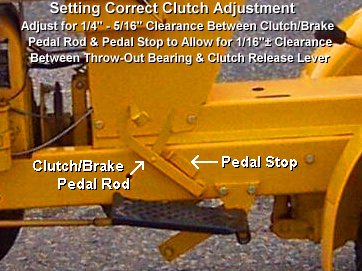 When the clutch/brake pedal
is fully disengaged (not depressed), no part of the
clutch release/throw-out bearing is supposed
to make contact with the clutch release lever.
Otherwise, the clutch
release/throw-out bearing will turn the same RPM as the engine. If
these continually make contact with the engine running and while the tractor
is in motion, the driveshaft will continually spin the
throw-out bearing, causing it to overheat
and eventually burn-out, and the contact area on the
release lever will likely to wear excessively.
The excessive heat from the overheated throw-out bearing could travel into
and weaken (damage) the front end of the main pressure spring too, making
it place less pressure against the clutch disc. This will occur with ordinary
lawn and garden, and competition pulling tractors alike. Therefore, to set
the correct clearance and "safe" operating distance between the
throw-out
bearing and release lever, with the
clutch/brake pedal fully disengaged (not depressed) and the clutch/brake
pedal arm/lever against the pedal stop, which is a small angled steel spot-welded
to the tractor frame, and with a pedal return spring installed, turn the
self-locking nut on the L-shaped clutch adjustment/release rod (that's on
the lower part of the release lever) until there's
9/32" - 5/16" of clearance between the pedal arm/lever and pedal stop. This
will allow for .050" - .060" (approximately 1/16") of clearance between the
throw-out
bearing and release lever. The clutch
disc should release fully from the pressure plates and the driveshaft should
immediately stop rotating with the engine running when the pedal is depressed.
When the clutch/brake pedal
is fully disengaged (not depressed), no part of the
clutch release/throw-out bearing is supposed
to make contact with the clutch release lever.
Otherwise, the clutch
release/throw-out bearing will turn the same RPM as the engine. If
these continually make contact with the engine running and while the tractor
is in motion, the driveshaft will continually spin the
throw-out bearing, causing it to overheat
and eventually burn-out, and the contact area on the
release lever will likely to wear excessively.
The excessive heat from the overheated throw-out bearing could travel into
and weaken (damage) the front end of the main pressure spring too, making
it place less pressure against the clutch disc. This will occur with ordinary
lawn and garden, and competition pulling tractors alike. Therefore, to set
the correct clearance and "safe" operating distance between the
throw-out
bearing and release lever, with the
clutch/brake pedal fully disengaged (not depressed) and the clutch/brake
pedal arm/lever against the pedal stop, which is a small angled steel spot-welded
to the tractor frame, and with a pedal return spring installed, turn the
self-locking nut on the L-shaped clutch adjustment/release rod (that's on
the lower part of the release lever) until there's
9/32" - 5/16" of clearance between the pedal arm/lever and pedal stop. This
will allow for .050" - .060" (approximately 1/16") of clearance between the
throw-out
bearing and release lever. The clutch
disc should release fully from the pressure plates and the driveshaft should
immediately stop rotating with the engine running when the pedal is depressed.
 Use a
9/16" size boxed-in ratcheting wrench to
make the Cub Cadet garden tractor clutch adjustment much easier. And an accurate
way to check for the correct clearance between the
clutch release/throw-out bearing and clutch
release lever is to use a 7mm or 5/16" rod or
square stock as a thickness gauge. When the self-locking nut on the L-shaped
adjustment/release rod is turned clockwise (when facing the front of the
tractor), this decreases the clearance, and when the nut is turned
counterclockwise, this increases the clearance. Also, if a tractor doesn't
already have one, definitely install a pedal return spring
(extension spring) of the correct length on the clutch
adjustment/release rod to the hole in the cross member that's welded between
the frame rails so pressure from the release lever
will be taken off the clutch release/throw-out
bearing when the clutch/brake pedal is fully disengaged (not depressed)
to prevent from premature and excessive wearing of the clutch release/throw-out
bearing and/or release lever.
[Return to Previous Section, Paragraph
or Website]
Use a
9/16" size boxed-in ratcheting wrench to
make the Cub Cadet garden tractor clutch adjustment much easier. And an accurate
way to check for the correct clearance between the
clutch release/throw-out bearing and clutch
release lever is to use a 7mm or 5/16" rod or
square stock as a thickness gauge. When the self-locking nut on the L-shaped
adjustment/release rod is turned clockwise (when facing the front of the
tractor), this decreases the clearance, and when the nut is turned
counterclockwise, this increases the clearance. Also, if a tractor doesn't
already have one, definitely install a pedal return spring
(extension spring) of the correct length on the clutch
adjustment/release rod to the hole in the cross member that's welded between
the frame rails so pressure from the release lever
will be taken off the clutch release/throw-out
bearing when the clutch/brake pedal is fully disengaged (not depressed)
to prevent from premature and excessive wearing of the clutch release/throw-out
bearing and/or release lever.
[Return to Previous Section, Paragraph
or Website]
To disassemble the clutch components from the driveshaft, this is how I do it:
For safety, a
hydraulic press should be used to compress the large pressure
spring on the driveshaft to reassemble the clutch components!
To test how well the clutch will release out of the tractor, place the clutch assembly in the hydraulic press with each end of the release lever on a couple of blocks, and apply slight downward pressure on the end of the driveshaft. The clutch disc should rotate or "move around" freely without binding. If the disc doesn't rotate or binds, redo your work to find out what went wrong.
How to Fix a "Sticking" Cub Cadet Garden Tractor Drive Clutch (when it will not release) -
Before reassembling the clutch assembly, apply a thin coat of automotive grease on the area of the driveshaft where the throw-out bearing and where the rear pressure plate slides back and forth. The grease will assure full clutch disengagement, lessen wear to the driveshaft, and it will prevent the rear pressure plate from sticking to the driveshaft due to rust if the tractor is stored in a damp environment. Also, while the rear pressure plate is off the driveshaft, to prevent it from binding on the 2nd coiled/spiral pin, which can prevent the clutch from disengaging, widen the slot slightly with a flat file or on the edge of the blade on a chopsaw. (Be sure to wear safety glasses!) And it'll be a good idea to drill a small hole near the center of the rear pressure plate to relieve the air that can get trapped between the pressure plates.
Advertisement: (Prices are subject to change without notice.)
| Click here to contact A-1 Miller's Performance Enterprises to place an order, send your parts for repairing, and/or for FREE professional and honest technical customer service assistance and support and payment options. Please contact A-1 Miller's if you need a part or parts, or service(s) performed that's not listed or mentioned in this website. | |||
| The Much Over-Looked Clutch Release Lever
Clevis Pin -
|
|||
 New
Clutch Hanger Support Brackets. Fits IH Cub Cadet narrow frame garden tractor
models 70, 71, 72, 73, 100, 102, 104, 106, 122, 124 and 126. It's recommended
that the angled-shaped clevis/hinge/pivot pin (listed above) be used with
these parts to reduce wear to holes. New
Clutch Hanger Support Brackets. Fits IH Cub Cadet narrow frame garden tractor
models 70, 71, 72, 73, 100, 102, 104, 106, 122, 124 and 126. It's recommended
that the angled-shaped clevis/hinge/pivot pin (listed above) be used with
these parts to reduce wear to holes.
|
|||
 New
Clutch Hanger Support Bracket. Fits IH Cub Cadet wide frame garden tractor
models 86, 108, 128, 800, 1000 and 1200. Also for models 1250, 1450 and 1650
with a hydrostatic disconnect attachment. It's recommended that the
angled-shaped clevis/hinge/pivot pin (listed above) be used with these parts
to reduce wear to holes. New
Clutch Hanger Support Bracket. Fits IH Cub Cadet wide frame garden tractor
models 86, 108, 128, 800, 1000 and 1200. Also for models 1250, 1450 and 1650
with a hydrostatic disconnect attachment. It's recommended that the
angled-shaped clevis/hinge/pivot pin (listed above) be used with these parts
to reduce wear to holes.
|
|||
 New
Clutch Hanger Support Bracket. Fits IH- or MTD-built Cub Cadet spread frame
garden tractor models 580, 582, 1050, 1604, 1606 and 1806. May also fit model
1535. It's recommended that the angled-shaped clevis/hinge/pivot pin (listed
above) be used with these parts to reduce wear to holes. New
Clutch Hanger Support Bracket. Fits IH- or MTD-built Cub Cadet spread frame
garden tractor models 580, 582, 1050, 1604, 1606 and 1806. May also fit model
1535. It's recommended that the angled-shaped clevis/hinge/pivot pin (listed
above) be used with these parts to reduce wear to holes.
|
|||
 New
Clutch Hanger Support Bracket. Fits MTD-built Cub Cadet spread frame garden
tractor model 1535. May also fit models 580, 582, 1050, 1604, 1606 and 1806.
Requires shoulder bolt w/locknut. New
Clutch Hanger Support Bracket. Fits MTD-built Cub Cadet spread frame garden
tractor model 1535. May also fit models 580, 582, 1050, 1604, 1606 and 1806.
Requires shoulder bolt w/locknut.
|
|||
  Clutch Release
Levers. Each fits Cub Cadet narrow frame garden tractor models 70, 71,
72, 73, 100, 102, 104, 106, 122, 124 and 126. Clutch Release
Levers. Each fits Cub Cadet narrow frame garden tractor models 70, 71,
72, 73, 100, 102, 104, 106, 122, 124 and 126.
|
|||
 Clutch
Adjustment/Release Rod. Fits IH Cub Cadet "Original" garden tractor. Length:
6-9/16" from middle of bend to end of threads. Clutch
Adjustment/Release Rod. Fits IH Cub Cadet "Original" garden tractor. Length:
6-9/16" from middle of bend to end of threads.
|
|||
 Nylon Insert
Self-Locking Nuts for 3/8" diameter threaded L-shaped clutch adjustment/release
rods listed above. Replace OEM adjusting nut with worn threads to maintain
correct clutch adjustment on virtually all Cub Cadet clutch drive garden
tractors. Grade 8 material with 3/8-24 UNF threads. NOTE: Use a (9/16"
size)
boxed-in ratcheting wrench for much easier and precise
clutch adjustment. Nylon Insert
Self-Locking Nuts for 3/8" diameter threaded L-shaped clutch adjustment/release
rods listed above. Replace OEM adjusting nut with worn threads to maintain
correct clutch adjustment on virtually all Cub Cadet clutch drive garden
tractors. Grade 8 material with 3/8-24 UNF threads. NOTE: Use a (9/16"
size)
boxed-in ratcheting wrench for much easier and precise
clutch adjustment.
|
|||
 Clutch Release
Tension Compression Springs. Fits all models of Cub Cadet clutch drive garden
tractors. Slides over threaded end of 3/8" diameter L-shaped clutch
release/adjustment rod (listed above). A must for proper adjustment in Cub
Cadet clutch drive garden tractors to prevent premature wear to
clutch release/throw-out bearing and clutch
release lever, and to prevent annoying rattling
sound when the clearance between the throw-out
bearing and release lever is set correctly. Clutch Release
Tension Compression Springs. Fits all models of Cub Cadet clutch drive garden
tractors. Slides over threaded end of 3/8" diameter L-shaped clutch
release/adjustment rod (listed above). A must for proper adjustment in Cub
Cadet clutch drive garden tractors to prevent premature wear to
clutch release/throw-out bearing and clutch
release lever, and to prevent annoying rattling
sound when the clearance between the throw-out
bearing and release lever is set correctly.
|
|||
Clutch
Pedal Return Spring. 2-1/2" Unextended Length. Fits Cub Cadet garden
tractor models 70, 71, 72, 100, 102, 104, 105, 122, 123, 124 and 125. Replace
damaged, weak or missing pedal return spring to prevent premature (and expensive)
wear to clutch release/throw-out bearing
and clutch release lever, and to prevent annoying
rattling sound when the clearance between the
throw-out bearing and release lever is adjusted correctly. OEM spring
no longer available from Cub Cadet.
|
How to Save a Used Clutch Release/Throw-Out Bearing - A proven,
ingenious and innovative concept by Brian Miller, because nobody else advertise
this.
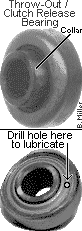 If
a used clutch release/throw-out bearing is
still pretty much "tight," but sounds noisy or "rattles" when you spin it
by hand, it could be saved from further wear by pumping it full of automotive
grease. The same can be done to a new bearing to ensure that it will last
a long time. (I've done this many times when I rebuild clutch assemblies
and have never had one complaint!) The fresh grease will help keep the
balls within the bearing well-lubricated and cool, preventing them from further
wear. But if the bearing is badly worn or if you're in doubt about doing
this, then perhaps install a new one. (Cub Cadet part # 741-3056)
If
a used clutch release/throw-out bearing is
still pretty much "tight," but sounds noisy or "rattles" when you spin it
by hand, it could be saved from further wear by pumping it full of automotive
grease. The same can be done to a new bearing to ensure that it will last
a long time. (I've done this many times when I rebuild clutch assemblies
and have never had one complaint!) The fresh grease will help keep the
balls within the bearing well-lubricated and cool, preventing them from further
wear. But if the bearing is badly worn or if you're in doubt about doing
this, then perhaps install a new one. (Cub Cadet part # 741-3056)
When assembling the clutch
components, never install the clutch release/throw-out bearing on the
driveshaft backwards! Install it with the collar (the center part that
sticks out) towards the clutch disc.
How to save a used clutch release/throw-out bearing:
 Using either a
needle grease injector (resembles a
hypodermic syringe that attaches to an
automotive grease gun) or a
chainsaw bar tip grease gun, pump the bearing through the
drilled hole until it's full of automotive grease. Rotate the bearing 180º
by hand and pump it again. It's full when the grease starts to ooze out of
the dust seals. By the way - the needle grease injector or chainsaw bar
tip grease gun can also be used to relubricate used sealed roller bearings
or add additional grease to new sealed roller bearings. And the chainsaw
bar tip grease gun comes in handy for lubricating a lot of different small
parts.
Using either a
needle grease injector (resembles a
hypodermic syringe that attaches to an
automotive grease gun) or a
chainsaw bar tip grease gun, pump the bearing through the
drilled hole until it's full of automotive grease. Rotate the bearing 180º
by hand and pump it again. It's full when the grease starts to ooze out of
the dust seals. By the way - the needle grease injector or chainsaw bar
tip grease gun can also be used to relubricate used sealed roller bearings
or add additional grease to new sealed roller bearings. And the chainsaw
bar tip grease gun comes in handy for lubricating a lot of different small
parts.
And for anyone who's ever wondered about this, when the Cub Cadet garden tractor clutch/brake pedal is fully depressed, the clutch release lever moves the throw-out bearing exactly 3/8" rearward on the driveshaft.
Advertisement: (Prices are subject to change without notice.)
| Click here to contact A-1 Miller's Performance Enterprises to place an order, send your parts for repairing, and/or for FREE professional and honest technical customer service assistance and support and payment options. Please contact A-1 Miller's if you need a part or parts, or service(s) performed that's not listed or mentioned in this website. |
 Teasing [Compression] Spring
and Protective Thrust Washer. Fits all models of Cub Cadet clutch drive garden
tractors, including Cub Cadet garden tractor models 1250, 1450 and 1650 equipped
with a hydrostatic disconnect attachment, and Cub Cadet "Original" garden
tractor (thrust washer not required). Spring allows for smooth engagement
of fiber clutch disc, and washer prevents spring from breaking. The thrust
washer goes between the rear slotted pressure plate and teasing spring. Purpose
of thrust washer is for each time the clutch is engaged, the rotating motion
of the throw-out bearing will sometimes cause the blunt end of the spring
to "catch" in the slot of the rear pressure plate, which twists the spring
a few thousandths of an inch. Overtime, this twisting motion creates metal
fatigue in the spring and could cause it to eventually break, even when used
with the OEM Cub Cadet cup/spacer listed below. The thrust washer prevents
the spring from breaking. A thoroughly tested, proven, ingenious and
innovative concept by Brian Miller. Please do not accept advertised copycat
products of this kind. (But I do appreciate them acknowledging my ingenuity
and intelligence.) FYI: There
is a custom-made sleeve available from an aftermarket vendor that goes over
the teasing spring (much like the cup/spacer listed below). But being the
coils of the teasing spring does not expand outward when the clutch is engaged,
this sleeve will not prevent the spring from possibly twisting and breaking. Teasing [Compression] Spring
and Protective Thrust Washer. Fits all models of Cub Cadet clutch drive garden
tractors, including Cub Cadet garden tractor models 1250, 1450 and 1650 equipped
with a hydrostatic disconnect attachment, and Cub Cadet "Original" garden
tractor (thrust washer not required). Spring allows for smooth engagement
of fiber clutch disc, and washer prevents spring from breaking. The thrust
washer goes between the rear slotted pressure plate and teasing spring. Purpose
of thrust washer is for each time the clutch is engaged, the rotating motion
of the throw-out bearing will sometimes cause the blunt end of the spring
to "catch" in the slot of the rear pressure plate, which twists the spring
a few thousandths of an inch. Overtime, this twisting motion creates metal
fatigue in the spring and could cause it to eventually break, even when used
with the OEM Cub Cadet cup/spacer listed below. The thrust washer prevents
the spring from breaking. A thoroughly tested, proven, ingenious and
innovative concept by Brian Miller. Please do not accept advertised copycat
products of this kind. (But I do appreciate them acknowledging my ingenuity
and intelligence.) FYI: There
is a custom-made sleeve available from an aftermarket vendor that goes over
the teasing spring (much like the cup/spacer listed below). But being the
coils of the teasing spring does not expand outward when the clutch is engaged,
this sleeve will not prevent the spring from possibly twisting and breaking.
|
Cup/Spacer for Teasing
Spring listed above. Specifically used only in Cub Cadet clutch drive garden
tractor models 580, 582, 800, 1000, 1200, 1535, 1604, 1606 and 1806, including
Cub Cadet garden tractor models 1250, 1450 and 1650 equipped with a hydrostatic
disconnect attachment. .633" overall length. IMPORTANT: When installing
this part on the driveshaft, the wide/flared-end faces forward and the narrow
end goes against the throw-out bearing. And do not install this part in any
other model of Cub Cadet garden tractor then listed above in an attempt to
prevent the teasing spring from possibly breaking over time. (Use the protective
thrust washer listed above instead.) Doing so will position the throw-out
bearing further back on the driveshaft than in the original position and
not allow the clutch disc to either fully disengage or disengage at all.
  Steel Spacer to go with [Teasing Spring] Cup listed above.
Being the OEM Cub Cadet 2" length teasing spring spacer for the Cub Cadet
garden tractor model 1050 clutch assembly is no longer available, use this
spacer with the teasing spring cup/spacer (and thrust washer) listed above
so these will duplicate the OEM part. 1-3/8" length. IMPORTANT:
Apply grease on driveshaft before installing spacer and cup for easier clutch
disengagement. Steel Spacer to go with [Teasing Spring] Cup listed above.
Being the OEM Cub Cadet 2" length teasing spring spacer for the Cub Cadet
garden tractor model 1050 clutch assembly is no longer available, use this
spacer with the teasing spring cup/spacer (and thrust washer) listed above
so these will duplicate the OEM part. 1-3/8" length. IMPORTANT:
Apply grease on driveshaft before installing spacer and cup for easier clutch
disengagement.
|
 Clutch Release/Throw-Out
Bearings. Fits and designed for IH Cub Cadet narrow frame garden tractor
models 70, 71, 72, 73, 100, 102, 104, 106, 122, 124 and 126. Bearing dimensions:
5/8" I.D. x 1.570" O.D. NOTE: The protruding center part of the bearing
faces forward in the tractor, toward the engine. IMPORTANT: To prevent from
prematurely wearing or burning up the throw-out bearing and possibly damaging
the clutch release lever, make sure the clutch release spring is installed,
and keep your foot off the clutch/brake pedal (do not "ride the clutch")
while the tractor is in motion. Clutch Release/Throw-Out
Bearings. Fits and designed for IH Cub Cadet narrow frame garden tractor
models 70, 71, 72, 73, 100, 102, 104, 106, 122, 124 and 126. Bearing dimensions:
5/8" I.D. x 1.570" O.D. NOTE: The protruding center part of the bearing
faces forward in the tractor, toward the engine. IMPORTANT: To prevent from
prematurely wearing or burning up the throw-out bearing and possibly damaging
the clutch release lever, make sure the clutch release spring is installed,
and keep your foot off the clutch/brake pedal (do not "ride the clutch")
while the tractor is in motion.
|
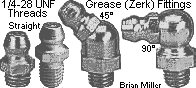 Zerk
Grease Fittings. For preventive maintenance, if a grease fitting isn't
already installed, one should be installed in [one piece] wheel hubs or outer
tubing of a rotating shaft so the [unshielded] bearings/bushings or shaft
will last longer when lubricated once a year with an
automotive grease gun. Do not use a grease fitting on split
rim wheels. Remember - the moving part will likely wear more than the stationary
part. To install a grease fitting, drill a 13/64" hole, and use a 1/4-28
UNF TAPER hand tap to cut new threads for installation of the fitting.
Click or tap here to
learn how to professionally drill for and cut new threads. FYI - If a
grease fitting needs to be used in a thin-wall steel tubing (that's too thin
to cut deep enough threads into so the threads on the grease fitting will
not interfere with the inner shaft) to lubricate a moving inner shaft, weld
a
jam nut with 1/4-28 UNF threads on the tubing, then drill
a 3/16" hole nut/tubing, and install the grease fitting (with short threads)
in the nut. Remember - grease fittings provide
preventive maintenance when they're used regularly. Because
grease cost less than any major repair of equipment.
[Return to Previous Section, Paragraph
or Website] Zerk
Grease Fittings. For preventive maintenance, if a grease fitting isn't
already installed, one should be installed in [one piece] wheel hubs or outer
tubing of a rotating shaft so the [unshielded] bearings/bushings or shaft
will last longer when lubricated once a year with an
automotive grease gun. Do not use a grease fitting on split
rim wheels. Remember - the moving part will likely wear more than the stationary
part. To install a grease fitting, drill a 13/64" hole, and use a 1/4-28
UNF TAPER hand tap to cut new threads for installation of the fitting.
Click or tap here to
learn how to professionally drill for and cut new threads. FYI - If a
grease fitting needs to be used in a thin-wall steel tubing (that's too thin
to cut deep enough threads into so the threads on the grease fitting will
not interfere with the inner shaft) to lubricate a moving inner shaft, weld
a
jam nut with 1/4-28 UNF threads on the tubing, then drill
a 3/16" hole nut/tubing, and install the grease fitting (with short threads)
in the nut. Remember - grease fittings provide
preventive maintenance when they're used regularly. Because
grease cost less than any major repair of equipment.
[Return to Previous Section, Paragraph
or Website]
|
Information About the Clutch Main Pressure Spring -
If a light-weight tractor with a governed engine (up to 4,000 RPM) is going to be used for general yard work, it's okay to use the stock OEM Cub Cadet garden tractor pressure spring with the OEM composite clutch disc. A good used stock OEM pressure spring and a new OEM spring should measure no less than 6-1/2" in uncompressed length. The maximum length is 7". But the compressed length (on the driveshaft with the clutch pedal fully depressed) is 5". If a spring have been used on a driveshaft with an overheated or burned-out clutch release/throw-out bearing, it's best to replace both. And if the OEM pressure plates have been resurfaced, but the clutch still slips in the heavier chores, perhaps a high pressure red (800± lb.) or yellow (1,150± lb.) spring may need to be installed. (See below Ê.)
If the tractor stops pulling about halfway down the track, and if the engine is still running, but the tires aren't spinning, then the clutch is slipping. For the OEM pressure plates to grip the clutch disc(s) firmly, the pressure spring must be a very stout one. The Cub Cadet garden tractor clutch pressure spring have about 250 psi of pressure and will probably not prevent the clutch from slipping in a competition pulling tractor. Therefore, a high pressure red (800± lb.) or yellow (1,150± lb.) spring works excellent with the OEM clutch disc or aluminum disc. The OEM clutch release lever may need to be extended 3" with either of these springs for easier clutch pedal depression.
How to Reinforce the Clutch Release Lever Brace on a Wide and Spread Frame Cub Cadet Garden Tractor When Using the Yellow Spring -
Install a piece of 1/8" x 1" x (you'll need to measure the length if the transaxle have been moved rearward) flat steel from the center of the clutch release lever brace back to one of the upper bolts on the front of the transaxle. Use grade 8 bolts so it can be removed later in case of repairs. This is much easier to do on a platform work table than on the floor or ground. [Return to Previous Section, Paragraph or Website]
Advertisement: (Prices are subject to change without notice.)
| Click here to contact A-1 Miller's Performance Enterprises to place an order, send your parts for repairing, and/or for FREE professional and honest technical customer service assistance and support and payment options. Please contact A-1 Miller's if you need a part or parts, or service(s) performed that's not listed or mentioned in this website. |
 OEM
Cub Cadet Garden Tractor Clutch Compression Springs. Suitable for
general lawn and garden work only; not recommended for competition pulling.
Approximately 6-3/4" to 7" uncompressed length. OEM
Cub Cadet Garden Tractor Clutch Compression Springs. Suitable for
general lawn and garden work only; not recommended for competition pulling.
Approximately 6-3/4" to 7" uncompressed length.
High Pressure Clutch Compression Springs; 800± lb. "Red" Spring, and 1,150± lb. "Yellow" Spring. Fits all models of Cub Cadet clutch drive garden tractors. When installed, either spring should be compressed to 4-1/2" in length. These springs are approximately 3/4" shorter in length than the OEM spring listed above, so if using the 3rd coiled/spiral pin hole in the middle of the driveshaft at its OEM location, a 3/4" steel spacer will need to be added behind the spring so it can apply maximum pressure against the clutch disc. When installing either of the springs listed below, use the original 3rd coiled/spiral pin hole location on the driveshaft, which should measure 9-1/4" from the very front of the driveshaft, or better yet, install one (for a stress proof steel driveshaft) or two (for a stainless steel driveshaft) split clamping/locking collar(s) at 9-1/4" from the very front of the driveshaft with a center support pillow block bearing and brace to prevent driveshaft wobble and reduce chance of driveshaft breakage at open RPM engine operation. And depending on type of clutch disc used, the Red spring is suitable for Hot-Stock and NQS Stock-Altered tractors, and the Yellow spring is suitable for 16hp Missouri Super-Stock, Pro-Stock and Modified tractors. Either are ideal for use with my aluminum clutch disc setup. With either of these aftermarket springs, the OEM clutch release lever should be extended 3" longer for easier depression of the clutch/brake pedal. Dimensions of each spring: 5/8" I.D. x 1-1/4" O.D. x 6" length.
|
| Solid Metal Motor Mount Kit for Cub Cadet "Quiet Line" Garden Tractors.
An original, ingenious, innovative concept invention by Brian Miller,
because I was the one who originally thought of, promoted and advertised
the use of this product. Please accept no copycat products of this kind.
(But I do appreciate them acknowledging my ingenuity and intelligence.)
[Return to previous section]
[Top of Page]
Details include:
|
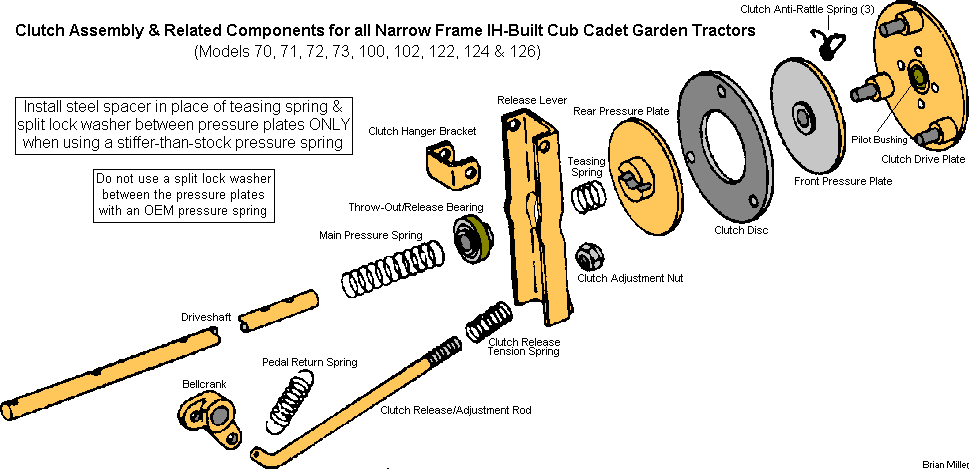


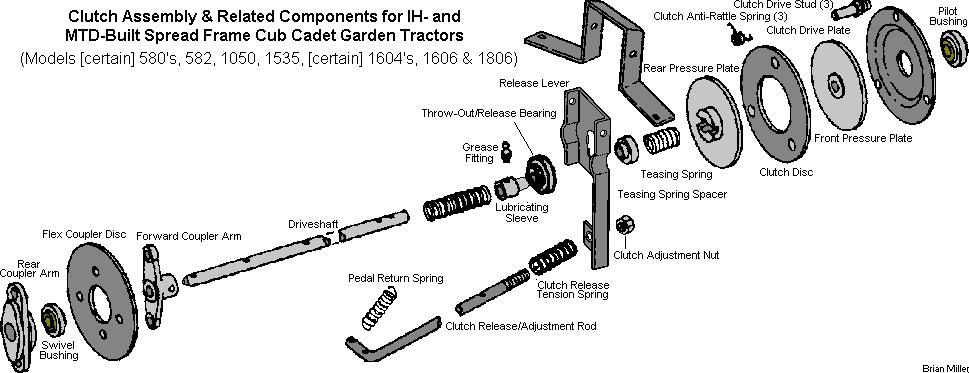
Advertisement: (Prices are subject to change without notice.)
| Click here to contact A-1 Miller's Performance Enterprises to place an order, send your parts for repairing, and/or for FREE professional and honest technical customer service assistance and support and payment options. Please contact A-1 Miller's if you need a part or parts, or service(s) performed that's not listed or mentioned in this website. |
Teasing [Compression] Spring
and Protective Thrust Washer. Spring allows for smooth engagement of the
fiber clutch disc, and the washer prevents the spring from breaking. Fits
all models of Cub Cadet clutch drive garden tractors, including Cub Cadet
garden tractor models 1250, 1450 and 1650 equipped with a hydrostatic disconnect
attachment, and Cub Cadet "Original" garden tractor (thrust washer not required).
The thrust washer goes between the rear slotted pressure plate and teasing
spring. Purpose of thrust washer is for each time the clutch is engaged,
the rotating motion of the throw-out bearing will sometimes cause the blunt
end of the spring to "catch" in the slot of the rear pressure plate, which
twists the spring a few thousandths of an inch. Overtime, the twisting creates
metal fatigue in the spring and could cause it to eventually break, even
when used with the cup/spacer listed below. The thrust washer prevents this
from happening. A proven, ingenious and innovative concept by Brian Miller.
Please do not accept advertised copycat products of this kind. (But I do
appreciate them acknowledging my ingenuity and intelligence.)
FYI: There is a custom-made sleeve
available from an aftermarket vendor that goes over the teasing spring (much
like the cup/spacer listed below). But being the coils of the teasing spring
does not expand outward when the clutch is engaged, this sleeve will not
prevent the spring from possibly twisting and breaking. Therefore, it's been
proven to use the protective thrust washer instead.
|
 Spherical, Swivel, Self-Aligning
5/8" I.D. Sealed Ball Bearing with Eccentric Locking Collar. Fits front of
IH "Original" Cub Cadet garden tractor driveshaft. Reuse OEM two-bolt, two-piece
stamped steel retainers. High quality aftermarket. Replaces discontinued
Cub Cadet part #'s IH-468390-R93 (collar bearing), IH-468391-R11 (eccentric
locking collar) and IH-376272-R1 (retainers). $20.00 each, plus shipping
& handling. Spherical, Swivel, Self-Aligning
5/8" I.D. Sealed Ball Bearing with Eccentric Locking Collar. Fits front of
IH "Original" Cub Cadet garden tractor driveshaft. Reuse OEM two-bolt, two-piece
stamped steel retainers. High quality aftermarket. Replaces discontinued
Cub Cadet part #'s IH-468390-R93 (collar bearing), IH-468391-R11 (eccentric
locking collar) and IH-376272-R1 (retainers). $20.00 each, plus shipping
& handling.
|
Bronze Bushing. Fits inside
IH Cub Cadet "Original" garden tractor clutch release collar housing (see
below). Grind or drill hole in bushing and lubricate through
Zerk grease fitting. Dimensions: 1" I.D. x
1.125" O.D. x 1" length. IMPORTANT: For
preventive maintenance, lubricate this part through
Zerk grease fitting with an
automotive grease gun once a year.
|
 Needle Thrust Bearing and
Two Thrust Washers. Goes inside IH Cub Cadet "Original" garden tractor clutch
release collar housing (see below). Dimensions: 1" I.D. x 1-9/16" O.D. x
.030" thickness thrust washers. IMPORTANT: For
preventive maintenance, lubricate these parts through
Zerk grease fitting with an
automotive grease gun once a year. Needle Thrust Bearing and
Two Thrust Washers. Goes inside IH Cub Cadet "Original" garden tractor clutch
release collar housing (see below). Dimensions: 1" I.D. x 1-9/16" O.D. x
.030" thickness thrust washers. IMPORTANT: For
preventive maintenance, lubricate these parts through
Zerk grease fitting with an
automotive grease gun once a year.
|
 IH Cub Cadet "Original" Garden
Tractor Clutch Release Collar Assembly. Replace worn-beyond-reuse clutch
release collar housing. Includes clutch release collar housing, new bronze
bushing and new thrust needle bearing with two new thrust washers. Replaces
discontinued Cub Cadet part # IH-376258-R11. IMPORTANT: For
preventive maintenance, lubricate this part through
Zerk grease fitting with an
automotive grease gun once a year. IH Cub Cadet "Original" Garden
Tractor Clutch Release Collar Assembly. Replace worn-beyond-reuse clutch
release collar housing. Includes clutch release collar housing, new bronze
bushing and new thrust needle bearing with two new thrust washers. Replaces
discontinued Cub Cadet part # IH-376258-R11. IMPORTANT: For
preventive maintenance, lubricate this part through
Zerk grease fitting with an
automotive grease gun once a year.
|
 A-1 Miller's Professional
Machine Services - A-1 Miller's Professional
Machine Services -
Repair Worn Hole in YOUR IH Cub Cadet "Original" Garden Tractor Clutch Arm to remove excessive free play in clutch/brake pedal. (The clutch arm fastens on the clutch/brake cross shaft and rotates slightly to disengage the drive clutch when the clutch/brake pedal is depressed.) FYI - The clutch arm is discontinued Cub Cadet part # IH-376276-R1. $30.00 for labor and installation of steel bushing/sleeve, plus return shipping & handling. |
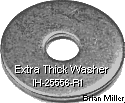 Extra Thick Flat Washer. Used
to apply pressure against rear pressure plate in IH Cub Cadet "Original"
garden tractor clutch assembly. Dimensions: 1-3/4" O.D. x approximately 5/32"
thickness x .626" center hole. Replaces discontinued Cub Cadet part #
IH-25556-R1. Extra Thick Flat Washer. Used
to apply pressure against rear pressure plate in IH Cub Cadet "Original"
garden tractor clutch assembly. Dimensions: 1-3/4" O.D. x approximately 5/32"
thickness x .626" center hole. Replaces discontinued Cub Cadet part #
IH-25556-R1.
|
  New OEM-quality
bronze pilot bushing for all pre-1981 gear drive IH Cub Cadet garden tractors,
except "Quiet Line" models. Also replacement bushing for inside the IH Cub
Cadet "Original" garden tractor pulley/clutch disc. $5.00 each, plus
shipping & handling. New OEM-quality
bronze pilot bushing for all pre-1981 gear drive IH Cub Cadet garden tractors,
except "Quiet Line" models. Also replacement bushing for inside the IH Cub
Cadet "Original" garden tractor pulley/clutch disc. $5.00 each, plus
shipping & handling.
Bore center of IH Cub Cadet "Original" garden tractor pulley/clutch disc
for installation of a high quality, high-speed sealed radial ball bearing.
(Intended mainly for competition pulling tractors with an engine that runs
at high RPM or wide open throttle.) A proven, ingenious and innovative
concept by Brian Miller. Please do not accept advertised copycat products
of this kind. (But I do appreciate them acknowledging my ingenuity and
intelligence.) Rebuild IH Cub Cadet "Original" garden tractor clutch assembly to OEM specs. $75.00-$100.00 labor only, extra charge for parts, plus return shipping & handling. Labor include: Disassemble complete unit, clean and inspect all parts, resurface both pressure plates to remove warpage and resurface composite clutch facings to restore flatness. Parts include: New bronze bushing in pulley/clutch disc and clutch release/throw-out bearing assembly (if needed), lubricate bushings and install new coiled/spiral pins. NOTE: If you're interested in having A-1 Miller's do the work for you, please send your clutch assembly when you're ready to the address listed below Ê . Package it securely so it won't get damaged or lost in shipping and please include a note in the package with your name, complete mailing address, phone number, email address (in case I have any questions) and a description of what you want done any other parts you may need. When the work is completed, I'll either call or email you an invoice with the total including shipping & handling. For payment, I accept cash (in person), money orders, cashier's checks, MasterCard, VISA, Discover (your credit/debit card will be charged the same day the items are shipped), Western Union Money Transfer and MoneyGram Money Transfers. Or you can pay A-1 Miller's through PayPal (my PayPal account name is my email address). If sending a money order, please include a note with your name, complete mailing address, phone number and a description of what the payment is for. My mailing address and phone number are listed below Ê . And I will return your rebuilt clutch assembly to you as soon as the work is completed after I receive your payment. Please contact me if you're interested in any of the above È parts or services.
|
Improving International Harvester's IH Cub Cadet "Original" Garden Tractor Clutch Assembly - [Top of Page]
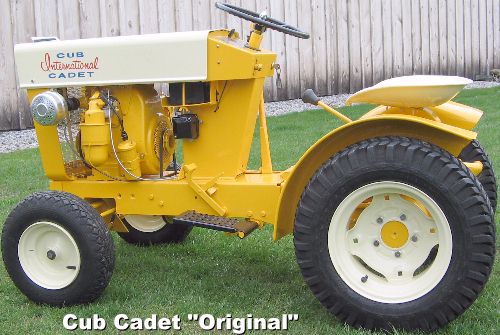 The very first Cub Cadet garden
tractor manufactured is the International Cub Cadet, better known as the
Cub Cadet "Original". The reason this particular tractor
is called the "Original" is because they're the first Cub Cadet garden tractor
that International Harvester made. That's why most folks nowadays call it
the Cub Cadet "Original". IH didn't have a model number because they were
all built basically the same, and they all share the same parts. At the time,
Cub Cadet probably didn't think they were going to build more (and improved)
models in the years following.
The very first Cub Cadet garden
tractor manufactured is the International Cub Cadet, better known as the
Cub Cadet "Original". The reason this particular tractor
is called the "Original" is because they're the first Cub Cadet garden tractor
that International Harvester made. That's why most folks nowadays call it
the Cub Cadet "Original". IH didn't have a model number because they were
all built basically the same, and they all share the same parts. At the time,
Cub Cadet probably didn't think they were going to build more (and improved)
models in the years following.
On these tractors, the power is transferred from a small pulley, that is on the engine, onto a larger pulley that's on the driveshaft by use of a V-belt, which act like a gear reduction. It's approximately a 1.6:1 reduction in driveshaft rotation. This means engine torque is increased approximately 1.6 times the driveshaft because the clutch/driveshaft. This increases the power and torque of the original 6¼hp engine into a 10hp engine (6¼ x 1.6 = 10).
Replacing the Drive Belt in a Cub Cadet "Original" Garden Tractor -
To remove and install the drive belt on an IH Cub Cadet "Original" garden tractor, the entire clutch assembly needs to be removed. After installing the belt and reinstalling the clutch assembly, the belt needs to be tightened by pulling down on the front brace of the clutch assembly (use a pry bar), and tighten the bolts on each side of the frame. This is much easier to do on a platform work table than on the floor or ground.
Convert the V-Belt Drive System to a Chain/Sprocket Drive -
The V-belt on the Cub Cadet "Original" garden tractor can be converted for use with a chain and sprocket drive. This system works great because there'll no belt to slip or rob the engine of horsepower. To make this possible:
Repairing the Drive Clutch -
If the drive clutch holds well, but will not release at times, this means the sliding parts on the driveshaft are dry or the old grease have accumulated dirt and/or have "dried up," causing the parts to bind on the driveshaft.
How to Disassemble and Reassemble the IH Cub Cadet "Original" Garden Tractor Clutch Assembly -
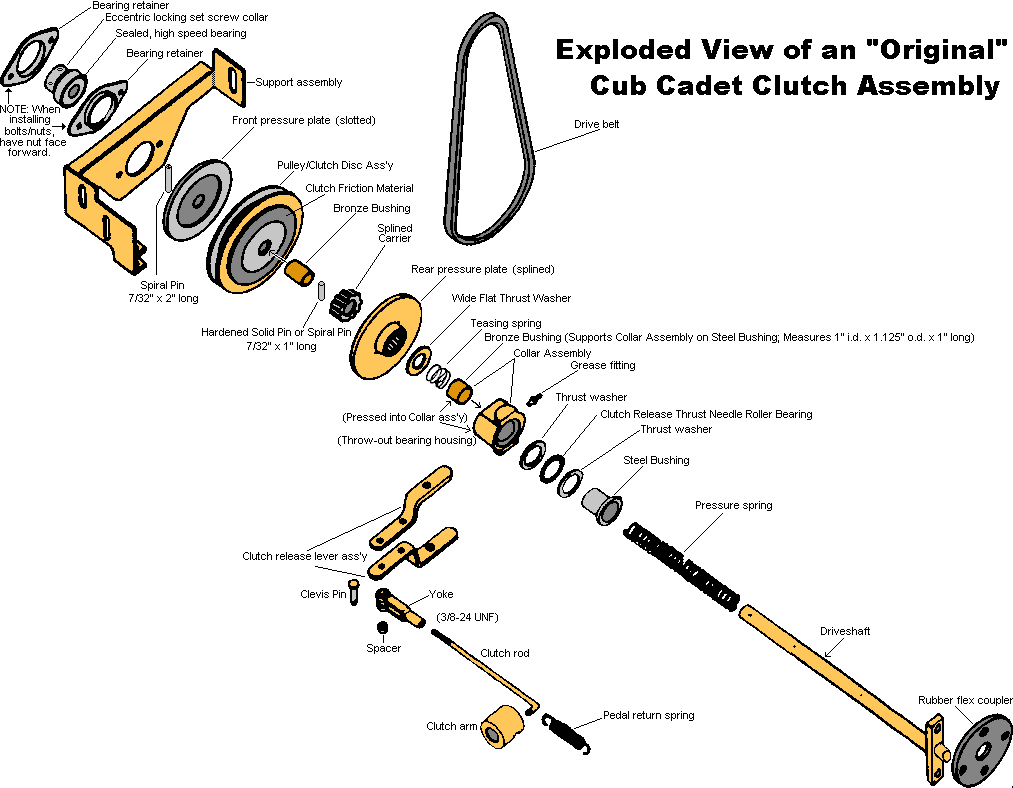

But if the clutch slips, performing the following should cure the problem:
First, resurface the cast iron pressure plates on a large, flat disc or belt sander until they're perfectly flat. (Sanders are not just for woodworking.) If the clutch discs (which is part of the pulley) aren't worn excessively, they can be sanded flat as well to match the flatness of the pressure plates. Just remove the raised places, no more. But if the composite material is worn thin or if you have doubts that it will not grip well, then install new clutch facings on the pulley.
If the clutch composite material "peels off" or comes loose from the pulley, it can be reattached with a high strength adhesive, such as Krazy Glue, Super Glue, Gorilla Glue, etc. FYI - When storing an opened container of Super Glue or liquid threadlock material, store it upright and not laying flat. The [capped] tip will not dry out and clog when stored upright. As soon as the composite material is adhered on the pulley, place the clutch/pulley assembly between two thick flat steel plates to cover the entire composite material, then place them in a hydraulic press and apply light pressure to squeeze out any air bubbles that may get trapped so the composite material will have a stronger bond and lay flat. If a hydraulic press isn't available, then using one of the tires that's on a car or truck will place enough pressure, too. After the glue have dried, lightly sand the composite material on a large, flat disc or belt sander to ensure true flatness.
For even better clutch adhesion or "holding power," the OEM pressure spring can be replaced with a high pressure red (800± lb.) or yellow (1,150± lb.) spring. Be sure to drill the 3rd hole to 1/4" and install a heavy coiled/spiral pin, too! Install a new bronze bushing in the clutch release/throw-out bearing if it's worn. Then lubricate the clutch release/throw-out bearing through the factory-installed Zerk grease fitting. Under normal use, the clutch release/throw-out bearing needs to be lubricated once a year for preventive maintenance. Because grease cost a lot less than any mechanical part(s)!
And as far as I'm aware, new composite facings for the IH Cub Cadet "Original"
garden tractor clutch is not available from any source. But 6061 aluminum
can be used as clutch facings on the IH Cub Cadet "Original" garden tractor
clutch pulley. The dimensions of the fabricated aluminum clutch facings are
as follows: 4-1/2" O.D. x 3" I.D. x 1/8" thick.
 Fasten the aluminum to the pulley
with six (for strength) 10-32 UNF x 1/2" length flat head brass screws equally
spaced apart on each side. Offset the threaded holes in the pulley so the
threads of the screws on one side will not interfere with the screws on the
other side. Countersink the heads of the screws into the aluminum with the
heads slightly below the surface of the aluminum. Make sure the aluminum
is perfectly flat before installing it on the pulley, too. And of course,
when using aluminum as clutch material, a stiffer-than-stock pressure spring,
such as the high pressure red (800± lb.) or
yellow (1,150± lb.) spring, will be required to prevent clutch slippage.
Fasten the aluminum to the pulley
with six (for strength) 10-32 UNF x 1/2" length flat head brass screws equally
spaced apart on each side. Offset the threaded holes in the pulley so the
threads of the screws on one side will not interfere with the screws on the
other side. Countersink the heads of the screws into the aluminum with the
heads slightly below the surface of the aluminum. Make sure the aluminum
is perfectly flat before installing it on the pulley, too. And of course,
when using aluminum as clutch material, a stiffer-than-stock pressure spring,
such as the high pressure red (800± lb.) or
yellow (1,150± lb.) spring, will be required to prevent clutch slippage.
IH Cub Cadet Garden Tractor Mechanical PTO Clutch Rebuild Kits and Rebuild Service - Click here to contact A-1 Miller's Performance Enterprises to place an order, send your parts for repairing, and/or for FREE professional and honest technical customer service assistance and support and payment options. Please contact A-1 Miller's if you need a part or parts, or service(s) performed that's not listed or mentioned in this website. | [Top of Page]
 Mule Drive V-Belt
Idler Pulley. Fits Cub Cadet garden tractor models 70, 71, 72, 73, 86, 100,
102, 104, 105, 106, 107, 108, 109, 122, 123, 124, 125, 126, 127, 128, 129,
147, 149, 169, 800, 1000, 1100, 1200, 1250, 1450 and 1650. Mule Drive V-Belt
Idler Pulley. Fits Cub Cadet garden tractor models 70, 71, 72, 73, 86, 100,
102, 104, 105, 106, 107, 108, 109, 122, 123, 124, 125, 126, 127, 128, 129,
147, 149, 169, 800, 1000, 1100, 1200, 1250, 1450 and 1650.
|
|
 Carbon Wear Button for IH
Cub Cadet Garden Tractor Mechanical PTO Clutch. Fits Cub Cadet garden tractor
models 70, 71, 72, 73, 86, 100, 102, 104, 105, 106, 107, 108, 109, 122, 123,
124, 125, 126, 127, 128, 129, 147, 149 and 169. This part installs in
the mower deck engagement lever on the frame of tractor. Makes contact with
the metal button to the right. Secure with high strength glue. OEM Cub
Cadet part # IH-473483-R2. $8.70 each, plus shipping & handling. Carbon Wear Button for IH
Cub Cadet Garden Tractor Mechanical PTO Clutch. Fits Cub Cadet garden tractor
models 70, 71, 72, 73, 86, 100, 102, 104, 105, 106, 107, 108, 109, 122, 123,
124, 125, 126, 127, 128, 129, 147, 149 and 169. This part installs in
the mower deck engagement lever on the frame of tractor. Makes contact with
the metal button to the right. Secure with high strength glue. OEM Cub
Cadet part # IH-473483-R2. $8.70 each, plus shipping & handling. |
 Metal Thrust Button for
IH Cub Cadet Garden Tractor Mechanical PTO Clutch. Fits Cub Cadet garden
tractor models 70, 71, 72, 73, 86, 100, 102, 104, 105, 106, 107, 108, 109,
122, 123, 124, 125, 126, 127, 128, 129, 147, 149 and 169. This part installs
in the center of the PTO clutch assembly. Makes contact with the carbon button
to the left. OEM Cub Cadet part # IH-473477-R3. $12.55 each, plus
shipping & handling. Metal Thrust Button for
IH Cub Cadet Garden Tractor Mechanical PTO Clutch. Fits Cub Cadet garden
tractor models 70, 71, 72, 73, 86, 100, 102, 104, 105, 106, 107, 108, 109,
122, 123, 124, 125, 126, 127, 128, 129, 147, 149 and 169. This part installs
in the center of the PTO clutch assembly. Makes contact with the carbon button
to the left. OEM Cub Cadet part # IH-473477-R3. $12.55 each, plus
shipping & handling. |
 Mechanical PTO
Clutch Rebuild Kit. Designed for and fits all narrow frame Cub Cadet models
70, 71, 73, 100, 102, 104, 105, 106, 107, 122, 123, 124, 125, 126, 127 and
147. (Unlike the tractors listed below, the model of tractors listed here
have a smaller mower deck, which require less pressure for the PTO clutch.)
OEM Cub Cadet part #'s 759-3490, IH-483525-R92, IH-545690-R92. $117.00
each, plus shipping & handling. Mechanical PTO
Clutch Rebuild Kit. Designed for and fits all narrow frame Cub Cadet models
70, 71, 73, 100, 102, 104, 105, 106, 107, 122, 123, 124, 125, 126, 127 and
147. (Unlike the tractors listed below, the model of tractors listed here
have a smaller mower deck, which require less pressure for the PTO clutch.)
OEM Cub Cadet part #'s 759-3490, IH-483525-R92, IH-545690-R92. $117.00
each, plus shipping & handling.
A-1 Miller's Professional Rebuild Service - Rebuild YOUR IH Cub Cadet mechanical PTO clutch assembly. $75.00 labor each, parts are extra charge, plus return shipping & handling.
A-1 Miller's Professional Rebuild Service - Rebuild YOUR IH Cub Cadet mechanical PTO clutch assembly. $75.00 labor each, parts are extra charge, plus return shipping & handling. |
|
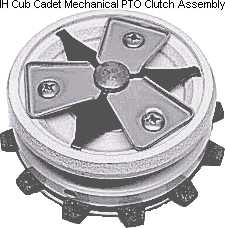 IH
Cub Cadet Mechanical PTO Clutch Assembly. Fully machined with new replacement
parts. Designed for and fits all narrow frame IH Cub Cadet models 70, 71,
73, 100, 102, 104, 105, 106, 107, 122, 123, 124, 125, 126, 127 and 147.
NOTE: Unlike the PTO clutch assembly listed below, this particular clutch
have one pressure spring for a smaller size mower deck. Comes with one
year workmanship warranty. OEM Cub Cadet part #'s 759-3490, IH-483525-R92,
IH-545690-R92. $300.00 each, plus shipping & handling. (When
available or in stock.) IH
Cub Cadet Mechanical PTO Clutch Assembly. Fully machined with new replacement
parts. Designed for and fits all narrow frame IH Cub Cadet models 70, 71,
73, 100, 102, 104, 105, 106, 107, 122, 123, 124, 125, 126, 127 and 147.
NOTE: Unlike the PTO clutch assembly listed below, this particular clutch
have one pressure spring for a smaller size mower deck. Comes with one
year workmanship warranty. OEM Cub Cadet part #'s 759-3490, IH-483525-R92,
IH-545690-R92. $300.00 each, plus shipping & handling. (When
available or in stock.)
IH Cub Cadet Mechanical PTO Clutch Assembly. Fully machined with new replacement parts. Designed for and fits solid-mounted engine wide frame IH Cub Cadet models 86, 108, 109, 128, 129, 149 and 169. NOTE: Unlike the PTO clutch assembly listed above, to prevent slippage when engaged, this particular clutch has two pressure springs for a larger size mower deck. Comes with one year workmanship warranty. OEM Cub Cadet part #'s 75903489 and IH-548352-R92. $350.00 each, plus shipping & handling. (When available or in stock.) A-1 Miller's Professional Rebuild Service - Rebuild YOUR IH Cub Cadet mechanical PTO clutch assembly. Comes with one year workmanship warranty. $100.00 labor each, replacement parts are extra charge, plus return shipping & handling. |
|
 1"
Ball Bearing with Eccentric Locking Collar. Fits IH Cub Cadet mechanical
PTO clutch assembly listed above, and IH Cub Cadet garden tractor models
70, 71, 72, 73, 86, 100, 102, 104, 105, 106, 107, 108, 109, 122, 123, 124,
125, 126, 127, 128, 129, 147, 149 and 169. NOTE: If the PTO clutch/pulley
assembly is already removed, and the ball bearing and locking are difficult
to remove, use a large 2-jaw gear puller (The
PROTO 4021 2-jaw gear puller works great for many tough
jobs) to forcibly pull the bearing and locking collar off the crankshaft.
See further below for how to safety remove a stubborn PTO clutch basket/pulley
with no damage to the part. 1"
Ball Bearing with Eccentric Locking Collar. Fits IH Cub Cadet mechanical
PTO clutch assembly listed above, and IH Cub Cadet garden tractor models
70, 71, 72, 73, 86, 100, 102, 104, 105, 106, 107, 108, 109, 122, 123, 124,
125, 126, 127, 128, 129, 147, 149 and 169. NOTE: If the PTO clutch/pulley
assembly is already removed, and the ball bearing and locking are difficult
to remove, use a large 2-jaw gear puller (The
PROTO 4021 2-jaw gear puller works great for many tough
jobs) to forcibly pull the bearing and locking collar off the crankshaft.
See further below for how to safety remove a stubborn PTO clutch basket/pulley
with no damage to the part.
|
|
A-1 Miller's Mechanical PTO Clutch Basket/Pulley Puller/Remover Tool for IH Cub Cadet Garden Tractors - An innovative concept by Brian Miller. [Top of Page]

 This is a fool-proof method to easily and safely remove the
basket/pulley without damaging it. Use this puller/remover tool with a 2-jaw
gear/pulley puller (The
PROTO 4021 2-jaw gear puller [shown to the right] works
great for many heavy duty jobs) and 1/2" impact wrench to remove a
manually-operated mechanical PTO clutch pulley/basket from the crankshaft
on IH Cub Cadet garden tractor models 70, 71, 72, 73, 86, 100, 102, 104,
105, 106, 107, 108, 109, 122, 123, 124, 125, 126, 127, 128, 129, 149 and
169. This versatile puller/remover tool can also be used to remove stubborn
steel pulleys and sprockets from other makes and models of garden tractor
engines, transmissions, transaxles, right angle gearboxes, etc.
This is a fool-proof method to easily and safely remove the
basket/pulley without damaging it. Use this puller/remover tool with a 2-jaw
gear/pulley puller (The
PROTO 4021 2-jaw gear puller [shown to the right] works
great for many heavy duty jobs) and 1/2" impact wrench to remove a
manually-operated mechanical PTO clutch pulley/basket from the crankshaft
on IH Cub Cadet garden tractor models 70, 71, 72, 73, 86, 100, 102, 104,
105, 106, 107, 108, 109, 122, 123, 124, 125, 126, 127, 128, 129, 149 and
169. This versatile puller/remover tool can also be used to remove stubborn
steel pulleys and sprockets from other makes and models of garden tractor
engines, transmissions, transaxles, right angle gearboxes, etc.
Fabricate this puller/remover tool from heavy gauge (1/4" wall thickness) 1-3/4" I.D. x 2-1/4" O.D. x 2" length steel tubing. Drill one 11/32" hole toward each end of the tool (this is so the tool can be used in either direction), and cut/grind/machine two slots 180º midway (on each side) of the tool for the jaws of a 2-jaw gear/pulley puller tool.
How to Use A-1 Miller's IH Cub Cadet Garden Tractor Mechanical PTO Pulley/Basket Puller/Remover Tool -
 Remove the cast iron PTO clutch/pulley assembly and ball
bearing/locking collar from the crankshaft. There's a total of 6 set screws,
a short one on top of a longer one in each hole. The long ones needs to be
removed before the pulley/clutch assembly can come off. FYI - Sometimes
the set screws in the IH Cub Cadet cast iron PTO clutch/pulley assembly will
not remove and get stripped out. When this happens, the only option is to
pull/remove the clutch/pulley from the crankshaft with a heavy duty
2 jaw gear puller. (The
PROTO 4021 2-jaw gear puller [shown to the right] works
great for many heavy duty jobs) with a
large heavy duty C-clamp (to keep the jaws of the puller
from spreading out on the angled groove V-pulley) and then use a
heavy duty 1/2" air impact wrench on the gear puller.
Unfortunately, doing this breaks out the set screw holes, which is unavoidable
and destroys the cast iron PTO clutch/pulley assembly. The only option is
to install a new or rebuilt replacement PTO clutch/pulley assembly with
anti-seize thread lubricant on all of the new set screws.
Remove the cast iron PTO clutch/pulley assembly and ball
bearing/locking collar from the crankshaft. There's a total of 6 set screws,
a short one on top of a longer one in each hole. The long ones needs to be
removed before the pulley/clutch assembly can come off. FYI - Sometimes
the set screws in the IH Cub Cadet cast iron PTO clutch/pulley assembly will
not remove and get stripped out. When this happens, the only option is to
pull/remove the clutch/pulley from the crankshaft with a heavy duty
2 jaw gear puller. (The
PROTO 4021 2-jaw gear puller [shown to the right] works
great for many heavy duty jobs) with a
large heavy duty C-clamp (to keep the jaws of the puller
from spreading out on the angled groove V-pulley) and then use a
heavy duty 1/2" air impact wrench on the gear puller.
Unfortunately, doing this breaks out the set screw holes, which is unavoidable
and destroys the cast iron PTO clutch/pulley assembly. The only option is
to install a new or rebuilt replacement PTO clutch/pulley assembly with
anti-seize thread lubricant on all of the new set screws.
How to Prevent the IH Cub Cadet Garden Tractor PTO Pulley/Basket from Loosening on the Crankshaft - [Top of Page]
Tools and Parts Required Are:
 Two 5/16-18 UNC x 5/8" length Allen set screws
Instructions:
 Remove the OEM set screws from
the hub in the pulley, and remove the pulley from the crankshaft. (If
necessary, use A-1 Miller's PTO Puller Puller Tool as instructed above to
avoid damage to the pulley.)
Remove the OEM set screws from
the hub in the pulley, and remove the pulley from the crankshaft. (If
necessary, use A-1 Miller's PTO Puller Puller Tool as instructed above to
avoid damage to the pulley.)
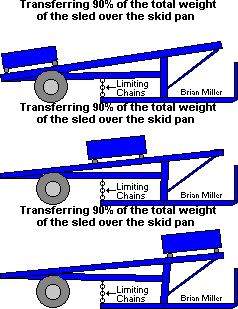 Click
Here for Detailed Illustrated Plans on How to Construct a Professional Pull-Back
and Self-Propelled Garden Tractor Pulling Sled (Available
Soon)
Click
Here for Detailed Illustrated Plans on How to Construct a Professional Pull-Back
and Self-Propelled Garden Tractor Pulling Sled (Available
Soon)
To place an order, send your item(s) for repairing,
and/or for customer service assistance, and FREE honest and accurate technical
support, please contact: A-1 Miller's Performance Enterprises | 1501
W. Old Plank Rd. | Columbia, MO (Missouri) 65203-9136 USA |
 Phone: 1-573-881-7229 (cell;
call or text, or leave a voicemail) or 1-573-554-9008 (new number; land line).
Call in your order or email us a list parts you need.
Payment Options. Please call Monday-Friday,
9am to 5pm, Central time zone, except holidays. If no answer, please try
again later. (When speaking with Brian on the phone, please be patient
and understanding because I stutter.)
Phone: 1-573-881-7229 (cell;
call or text, or leave a voicemail) or 1-573-554-9008 (new number; land line).
Call in your order or email us a list parts you need.
Payment Options. Please call Monday-Friday,
9am to 5pm, Central time zone, except holidays. If no answer, please try
again later. (When speaking with Brian on the phone, please be patient
and understanding because I stutter.)
 E-mail:
pullingtractor@aol.com. A-1 Miller's
shop is open to the public Monday-Friday, 9am to 5pm, Central time zone,
with an appointment on weekends, except holidays. If you're the kind of person
who don't trust delivery/shipping companies (mis)handling your high-dollar
and fragile merchandise, you can make the long drive to
A-1 Miller's shop to personally
purchase parts, or drop off and/or pick up your carburetor, clutch assembly,
engine parts, etc., for repairing and/or rebuilding. Or visit our (old) shop
at 1501 W. Old Plank Rd. to drop off your entire engine, transmission, transaxle,
entire garden tractor, small motorized vehicle, etc. Please call, text, leave
a voicemail or email me before coming so I'll be at my shop waiting for your
arrival. When you visit our shop, you will be dealing directly with the owner
for the best customer service. Directions
to our (old) shop |
1501 West Old Plank Road, Columbia, MO - Google Maps or
Map of 1501 West Old Plank
Road, Columbia, MO by MapQuest. "The road to a [trusted] friend's
house (or shop) is never long." Don't sacrifice quality workmanship for
distance. [Return To Previous Paragraph,
Section or Website]
E-mail:
pullingtractor@aol.com. A-1 Miller's
shop is open to the public Monday-Friday, 9am to 5pm, Central time zone,
with an appointment on weekends, except holidays. If you're the kind of person
who don't trust delivery/shipping companies (mis)handling your high-dollar
and fragile merchandise, you can make the long drive to
A-1 Miller's shop to personally
purchase parts, or drop off and/or pick up your carburetor, clutch assembly,
engine parts, etc., for repairing and/or rebuilding. Or visit our (old) shop
at 1501 W. Old Plank Rd. to drop off your entire engine, transmission, transaxle,
entire garden tractor, small motorized vehicle, etc. Please call, text, leave
a voicemail or email me before coming so I'll be at my shop waiting for your
arrival. When you visit our shop, you will be dealing directly with the owner
for the best customer service. Directions
to our (old) shop |
1501 West Old Plank Road, Columbia, MO - Google Maps or
Map of 1501 West Old Plank
Road, Columbia, MO by MapQuest. "The road to a [trusted] friend's
house (or shop) is never long." Don't sacrifice quality workmanship for
distance. [Return To Previous Paragraph,
Section or Website]
By the way - As business is booming, we're going to relocate our business soon at 12091 N. Rt. B, Hallsville, MO 65255 with a bigger, better, fully insulated, heated and air-conditioned building/shop (shouse) so we can provide many more high quality parts and professional services, and hire more reliable and knowledgeable help to have our customer's parts orders fulfilled sooner, parts repairs and engine rebuilds performed promptly without delay. We will also offer custom welding fabrication jobs and other custom services. We will also provide pick up and delivery service and perform professional repairs for various small engines and lawn & garden equipment! Photos of our new building/shop are posted here! 12091 N. Rt. B, Hallsville, MO 65255 - Google Maps
Payment Options, and We Ship to Canada and
Worldwide 
Item(s) in a package or cushioned envelope weighing less than 1 lb. is sent
by US Postal Service Airmail Letter Post for a 4-7 days delivery. Packaged
item(s) weighing over 1 lb. and up to 66 lb. is sent by US Postal Service
Airmail Parcel Post for a 4-10 days delivery. I cannot use the US Postal
Services' Flat Rate Priority Mail envelopes and boxes to ship outside U.S.
territories. Item(s) weighing over 67 lbs. or more is sent by FedEx Ground
or equivalent services. We try to keep our shipping cost to customers within
reason. Therefore, we don't ship our products in a fancy-looking package
with our company name and/or logo on it because most customers will just
toss it in the trash after they remove the contents. And being there is no
USPS tracking number outside the US, all I can do is make sure I write your
address correctly on the customs form and on your package.
My websites are not set up to process orders and accept payments. Therefore, to place an order with me, please call either number above or send me an email with a list of parts that you need, with your name, complete and correct postal mailing address and phone number. For payment options, I accept cash (in person), USPS Postal Money Orders, cashier's checks, business checks, MasterCard, VISA, Discover, American Express (please add 2.5% to the total amount for the credit/debit card processor's surcharge), Western Union Money Transfer or MoneyGram Money Transfers. If paying with a credit/debit card, please call me at either number below. Or to make a payment to me through PayPal, please click this link: https://www.paypal.com. Or use Cash App (username: pullingtractor) or Venmo (username: Pullingtractor) to make a payment to me. And be sure to mention a description of what the payment is for with your full name, postal address, phone number and email address. If sending a money order or cashier's check, please include a note in the envelope with your name, complete mailing address, phone number, email address and a description of what the payment is for. I'll make a note of your order when I have all your information, and I may have to order some of the parts on your list, which should take a few days to come in, but I will send everything to you as soon as I have the parts in stock after I receive your payment.







à Return to Main Pulling Tips Page | Return To Previous Website | Various Vendors Related to Tractor Pulling | Top of Page
Copyright © 1996-Present. This website created, designed and maintained by Brian Miller.
Click
Here for Detailed Illustrated Plans on How to Construct a Professional Pull-Back
and Self-Propelled Garden Tractor Pulling Sled (Available
Soon)
FYI - The self-propelled garden tractor pulling sled that I built is such
an excellent design, I realized later that I made something very special
when other people copied after it. - Brian Miller
 To
place an order, send your item(s) for repairing, and/or for customer service
assistance, and FREE honest and accurate technical support, please contact:
A-1 Miller's Performance Enterprises, 12091 N Route B, Hallsville, MO (Missouri)
65255-9604 USA. Please call in your order or send an email with a list parts
you need and your contact information.
Phone: 1-573-881-7229 (cell;
call, text or leave voicemail) or use
Whatsapp. Please call
Monday-Friday, 9am to 5pm, Central time zone, except holidays. If no answer,
please try again later. (When speaking with Brian on the phone, please
be patient and understanding because I stutter.)
E-mail:
pullingtractor@aol.com.
Payment Options. A-1 Miller's shop is open
to the public Monday-Friday, 9am to 5pm, Central time zone, with an appointment
on weekends, except holidays. If you're the kind of person who don't trust
delivery/shipping companies (mis)handling your high-dollar and fragile
merchandise, you can make the long drive to
A-1 Miller's new shop (click image
to the right) to personally purchase parts, or drop off and/or pick up your
carburetor, clutch assembly, engine and/or parts, etc., for repairing and/or
rebuilding. Or visit the address of our (old) shop mentioned above to drop
off your engine, transmission, transaxle, garden tractor, small motorized
vehicle, etc. We also custom build pulling tractors and other small vehicles.
Please contact me before coming so I'll be at my shop waiting for your arrival.
When you visit our shop, you will be dealing directly with the owner for
the best customer service.
12091 N Route B, Hallsville, MO - Google Maps "The road
to a [trusted] friend's house (or shop) is never long." Don't sacrifice quality
workmanship for distance. [Return
To Previous Paragraph, Section or Website]
To
place an order, send your item(s) for repairing, and/or for customer service
assistance, and FREE honest and accurate technical support, please contact:
A-1 Miller's Performance Enterprises, 12091 N Route B, Hallsville, MO (Missouri)
65255-9604 USA. Please call in your order or send an email with a list parts
you need and your contact information.
Phone: 1-573-881-7229 (cell;
call, text or leave voicemail) or use
Whatsapp. Please call
Monday-Friday, 9am to 5pm, Central time zone, except holidays. If no answer,
please try again later. (When speaking with Brian on the phone, please
be patient and understanding because I stutter.)
E-mail:
pullingtractor@aol.com.
Payment Options. A-1 Miller's shop is open
to the public Monday-Friday, 9am to 5pm, Central time zone, with an appointment
on weekends, except holidays. If you're the kind of person who don't trust
delivery/shipping companies (mis)handling your high-dollar and fragile
merchandise, you can make the long drive to
A-1 Miller's new shop (click image
to the right) to personally purchase parts, or drop off and/or pick up your
carburetor, clutch assembly, engine and/or parts, etc., for repairing and/or
rebuilding. Or visit the address of our (old) shop mentioned above to drop
off your engine, transmission, transaxle, garden tractor, small motorized
vehicle, etc. We also custom build pulling tractors and other small vehicles.
Please contact me before coming so I'll be at my shop waiting for your arrival.
When you visit our shop, you will be dealing directly with the owner for
the best customer service.
12091 N Route B, Hallsville, MO - Google Maps "The road
to a [trusted] friend's house (or shop) is never long." Don't sacrifice quality
workmanship for distance. [Return
To Previous Paragraph, Section or Website]
By the way - As business is booming, we relocated our business at 12091 N. Route B, Hallsville, MO 65255 with a new, bigger, better, fully insulated, heated and air-conditioned building/shop (shouse) so we can provide many more professional services and high quality parts, and hire more reliable and knowledgeable help to have our customer's parts orders fulfilled sooner, parts repaired sooner and engine rebuilds performed promptly without a long delay. We will also offer custom welding fabrication jobs and other custom services. And we also provide pick up and delivery service and perform professional repairs for various small engines and lawn & garden equipment! Photos of our new building/shop are posted here! 12091 N Rte B, Hallsville, MO - Google Maps
Payment Options, and We Ship to Canada and
Worldwide
Item(s) in a package or cushioned envelope weighing less than 1 lb. is sent
by US Postal Service Airmail Letter Post for a 4-7 days delivery. Packaged
item(s) weighing over 1 lb. and up to 66 lb. is sent by US Postal Service
Airmail Parcel Post for a 4-10 days delivery. I cannot use the US Postal
Services' Flat Rate Priority Mail envelopes and boxes to ship outside U.S.
territories. Item(s) weighing over 67 lbs. or more is sent by FedEx Ground
or equivalent services. We try to keep our shipping cost to customers within
reason. Therefore, we don't ship our products in a fancy-looking package
with our company name and/or logo on it because most customers will just
toss it in the trash after they remove the contents. And being there is no
USPS tracking number outside the US, all I can do is make sure I write your
address correctly on the customs form and on your package.
My websites are not set up to process orders and accept payments. Therefore, to place an order with me, please call either number above or send an email with a list of parts you need, with your name, complete and correct postal mailing address and phone number. For payment options, I accept cash (in person), USPS Postal Money Orders, cashier's checks, business checks, MasterCard, VISA, Discover, American Express (please add 2.5% to the total amount for the credit/debit card processor's surcharge). If paying with a credit/debit card, please call me at either number above. Or to make a payment to me through PayPal, please click this link: https://www.paypal.com. Or use Cash App (username: pullingtractor) or Venmo (username: Pullingtractor) to make a payment to me. And be sure to mention a description of what the payment is for with your full name, postal address, phone number and email address. I also accept payments through Western Union Money Transfer or MoneyGram Money Transfers. If sending a money order or cashier's check, please include a note in the envelope with your name, complete mailing address, phone number, email address and a description of what the payment is for. I'll make a note of your order when I have all your information, and I may have to order some of the parts on your list, which should take a few days to come in, but I will send everything to you as soon as I have the parts in stock after I receive your payment.
Return To Previous Website | Top of Page
Copyright © 1996-Present. This website created, designed and maintained by Brian Miller
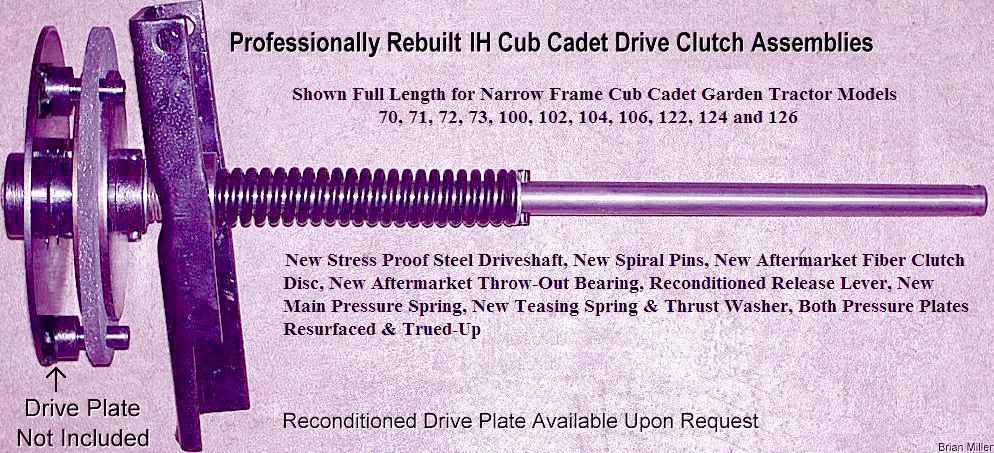

 Universal Drive Clutch Disc.
Has multiple holes drilled so it can be used in either MTD Farm King or Cub
Cadet garden tractors. High quality aftermarket. Very tough 100% composite
fiber material. Replaces MTD part # 717-0160 and Cub Cadet part # 961-3002
or 961-3011. $75.00 each, plus shipping & handling.
Universal Drive Clutch Disc.
Has multiple holes drilled so it can be used in either MTD Farm King or Cub
Cadet garden tractors. High quality aftermarket. Very tough 100% composite
fiber material. Replaces MTD part # 717-0160 and Cub Cadet part # 961-3002
or 961-3011. $75.00 each, plus shipping & handling.
 A-1 Miller's Professional
Gearbox Rebuild Service for Peerless (including most other makes and models
of right angle gearboxes) for the Mower Deck or Cub Cadet belt-drive garden
tractor models 482, 580, 582 Special, 1100, 1204 and 1604 with the Peerless
model 2300 transaxle. We also rebuild most other makes and models of
right angle gearboxes used in garden tractors, on mower decks, and used
elsewhere, as long as replacement parts are available. Repair price varies
depending on which parts needs to be replaced and/or repaired.
$200.00± for parts and labor, plus return shipping & handling.
A-1 Miller's Professional
Gearbox Rebuild Service for Peerless (including most other makes and models
of right angle gearboxes) for the Mower Deck or Cub Cadet belt-drive garden
tractor models 482, 580, 582 Special, 1100, 1204 and 1604 with the Peerless
model 2300 transaxle. We also rebuild most other makes and models of
right angle gearboxes used in garden tractors, on mower decks, and used
elsewhere, as long as replacement parts are available. Repair price varies
depending on which parts needs to be replaced and/or repaired.
$200.00± for parts and labor, plus return shipping & handling.
 High quality aftermarket. Long
lasting premium belt. 1/2" wide x 33" length. Replaces Cub Cadet part # 954-3000.
$10.00 each, plus shipping & handling.
High quality aftermarket. Long
lasting premium belt. 1/2" wide x 33" length. Replaces Cub Cadet part # 954-3000.
$10.00 each, plus shipping & handling.


 Driveshafts for IH- and MTD-built
Cub Cadet Clutch Drive Garden Tractor models 70, 71, 72, 73, 86, 100, 102,
104, 106, 108, 122, 124, 126, 128, 580, 582, 800, 1000, 1050, 1200, 1604,
1606 and 1806, including models 1250, 1450 and 1650 with a hydrostatic disconnect
attachment. NOTE: These driveshafts are made to
order. When ordering, please specify model of Cub Cadet and possibly exact
length and exactly where the coiled/spiral pin holes needs to be drilled.
Please indicate if you want the 3rd hole drilled for the main pressure spring
or if you are going to use a
Driveshafts for IH- and MTD-built
Cub Cadet Clutch Drive Garden Tractor models 70, 71, 72, 73, 86, 100, 102,
104, 106, 108, 122, 124, 126, 128, 580, 582, 800, 1000, 1050, 1200, 1604,
1606 and 1806, including models 1250, 1450 and 1650 with a hydrostatic disconnect
attachment. NOTE: These driveshafts are made to
order. When ordering, please specify model of Cub Cadet and possibly exact
length and exactly where the coiled/spiral pin holes needs to be drilled.
Please indicate if you want the 3rd hole drilled for the main pressure spring
or if you are going to use a  Driveshafts for IH Cub Cadet
Hydrostatic Drive Garden Tractor models 105, 107, 109, 123, 125, 127, 129,
147, 109, 129, 149 and 169. NOTE: These driveshafts, with the OEM factory
designed machined-down 3/8" diameter support end, are originally used with
Cub Cadet coupler arm with the 25/64" center hole (
Driveshafts for IH Cub Cadet
Hydrostatic Drive Garden Tractor models 105, 107, 109, 123, 125, 127, 129,
147, 109, 129, 149 and 169. NOTE: These driveshafts, with the OEM factory
designed machined-down 3/8" diameter support end, are originally used with
Cub Cadet coupler arm with the 25/64" center hole ( Driveshafts for Cub Cadet
Garden Tractor models 482, 580, 582 Special, 1100, 1204, 1604 1606 and
1806. (Belt drive models; engine to right angle gearbox w/Peerless model
2300 transaxle.)
Driveshafts for Cub Cadet
Garden Tractor models 482, 580, 582 Special, 1100, 1204, 1604 1606 and
1806. (Belt drive models; engine to right angle gearbox w/Peerless model
2300 transaxle.)  Driveshafts for MTD-built
Cub Cadet Hydrostatic Drive Garden Tractor models 680, 682, 782, 782D, 784,
882, 982, 1210, 1211, 1282, 1512, 1541, 1710, 1711, 1712, 1810, 1811, 1812
and 1860.
Driveshafts for MTD-built
Cub Cadet Hydrostatic Drive Garden Tractor models 680, 682, 782, 782D, 784,
882, 982, 1210, 1211, 1282, 1512, 1541, 1710, 1711, 1712, 1810, 1811, 1812
and 1860.


 3/8" Diameter x 1-3/4" Length
Heavy Duty Coiled/Spiral Pin for OEM IH Cub Cadet "Quiet Line" garden tractor
models 800, 1000 and 1200 "flexible" 3-pin clutch drive plate. (The longer
pin is to maintain balance of drive plate; do not grind it down to match
the other two pins.) To install this or above pin(s), grind off rivet heads
in drive plate, punch out remaining rivets, remove/install spiral pin(s),
and then use 1/4" x 1/2" length bolts w/locknuts to fasten flex plate to
drive plate. 12,600 P.S.I. breaking strength. $6.00 each, plus shipping
& handling.
3/8" Diameter x 1-3/4" Length
Heavy Duty Coiled/Spiral Pin for OEM IH Cub Cadet "Quiet Line" garden tractor
models 800, 1000 and 1200 "flexible" 3-pin clutch drive plate. (The longer
pin is to maintain balance of drive plate; do not grind it down to match
the other two pins.) To install this or above pin(s), grind off rivet heads
in drive plate, punch out remaining rivets, remove/install spiral pin(s),
and then use 1/4" x 1/2" length bolts w/locknuts to fasten flex plate to
drive plate. 12,600 P.S.I. breaking strength. $6.00 each, plus shipping
& handling. 5-1/2" Diameter Nylon
Hydrostatic Drive Cooling Fan. Fits Cub Cadet garden tractor models 105,
107, 123, 125 and 147. OEM Cub Cadet part # IH-394065-R92. $23.20
each, plus shipping & handling.
5-1/2" Diameter Nylon
Hydrostatic Drive Cooling Fan. Fits Cub Cadet garden tractor models 105,
107, 123, 125 and 147. OEM Cub Cadet part # IH-394065-R92. $23.20
each, plus shipping & handling.
 5" Diameter Nylon
Hydrostatic Drive Cooling Fan. Fits Cub Cadet garden tractor models 109,
129, 149, 169, 1250, 1450 and 1650. OEM Cub Cadet part # IH-547749-R2.
$19.10 each, plus shipping & handling.
5" Diameter Nylon
Hydrostatic Drive Cooling Fan. Fits Cub Cadet garden tractor models 109,
129, 149, 169, 1250, 1450 and 1650. OEM Cub Cadet part # IH-547749-R2.
$19.10 each, plus shipping & handling.
 7" Diameter Nylon
Hydrostatic Drive Cooling Fan. Fits Cub Cadet garden tractor models 680,
682, 782, 782D, 784, 882, 1204, 1210, 1211, 1282, 1512, 1711, 1712, 1810,
1811, 1812 and 1860. OEM Cub Cadet part # 931-3009. $30.90 each, plus
shipping & handling.
7" Diameter Nylon
Hydrostatic Drive Cooling Fan. Fits Cub Cadet garden tractor models 680,
682, 782, 782D, 784, 882, 1204, 1210, 1211, 1282, 1512, 1711, 1712, 1810,
1811, 1812 and 1860. OEM Cub Cadet part # 931-3009. $30.90 each, plus
shipping & handling.
 Screws with Lock Nut to secure
fan on driveshaft. #10 x 1-1/2" length.
Screws with Lock Nut to secure
fan on driveshaft. #10 x 1-1/2" length.
 7" Diameter Nylon
Hydrostatic Drive Cooling Fan. Fits Cub Cadet garden tractor models 982,
984, 986, 1872, 1912, 1914 and 2072 with a 3/4" driveshaft. OEM Cub Cadet
part # 931-3013. $49.00 each, plus shipping & handling.
7" Diameter Nylon
Hydrostatic Drive Cooling Fan. Fits Cub Cadet garden tractor models 982,
984, 986, 1872, 1912, 1914 and 2072 with a 3/4" driveshaft. OEM Cub Cadet
part # 931-3013. $49.00 each, plus shipping & handling.
 7" Diameter Nylon
Hydrostatic Drive Cooling Fan. Fits Cub Cadet garden tractor models 1340,
1440, 1541, 1641, 1782, 1860, 1861, 1863, 1864, 1882, 2082, 2084, 2086, 2130,
2135, 2140, 2145, 2150, 2155, 2160, 2164, 2165, 2182, 2185, 2185, 2284, 3165,
3185, 3186, 3205 and 3225. OEM Cub Cadet part # 931-3095. $27.15 each,
plus shipping & handling.
7" Diameter Nylon
Hydrostatic Drive Cooling Fan. Fits Cub Cadet garden tractor models 1340,
1440, 1541, 1641, 1782, 1860, 1861, 1863, 1864, 1882, 2082, 2084, 2086, 2130,
2135, 2140, 2145, 2150, 2155, 2160, 2164, 2165, 2182, 2185, 2185, 2284, 3165,
3185, 3186, 3205 and 3225. OEM Cub Cadet part # 931-3095. $27.15 each,
plus shipping & handling. Steel Angled Driveshaft Support
Brace for use with Pillow Block Bearing listed above. For use in all models
of IH- and MTD-built Cub Cadet competition garden pulling tractors. Made
of 1/8" thickness x 2-1/2" width angled steel with holes drilled for pillow
block bearing. When securely fastened or welded to Cub Cadet frame, this
brace will not crack or break, even under severe vibration. NOTE: Before
fastening or welding this brace between the Cub Cadet garden tractor frame
rails, first install pillow block bearing w/housing on assembled driveshaft,
connect driveshaft to transaxle and engine, tighten engine mounting bolts
to tractor frame, then fasten this angle brace to pillow block bearing. This
will guarantee the pillow block bearing and brace is in perfect alignment
and centered with the driveshaft. Otherwise, the driveshaft will be noisy.
Then permanently weld angle brace to tractor frame rails. See correct
installation below. Ê An ingenious
and innovative concept by Brian Miller. Please do not accept advertised copycat
products of this kind. (But I do appreciate them acknowledging my ingenuity
and intelligence.)
Steel Angled Driveshaft Support
Brace for use with Pillow Block Bearing listed above. For use in all models
of IH- and MTD-built Cub Cadet competition garden pulling tractors. Made
of 1/8" thickness x 2-1/2" width angled steel with holes drilled for pillow
block bearing. When securely fastened or welded to Cub Cadet frame, this
brace will not crack or break, even under severe vibration. NOTE: Before
fastening or welding this brace between the Cub Cadet garden tractor frame
rails, first install pillow block bearing w/housing on assembled driveshaft,
connect driveshaft to transaxle and engine, tighten engine mounting bolts
to tractor frame, then fasten this angle brace to pillow block bearing. This
will guarantee the pillow block bearing and brace is in perfect alignment
and centered with the driveshaft. Otherwise, the driveshaft will be noisy.
Then permanently weld angle brace to tractor frame rails. See correct
installation below. Ê An ingenious
and innovative concept by Brian Miller. Please do not accept advertised copycat
products of this kind. (But I do appreciate them acknowledging my ingenuity
and intelligence.) 

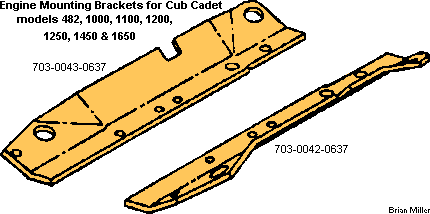
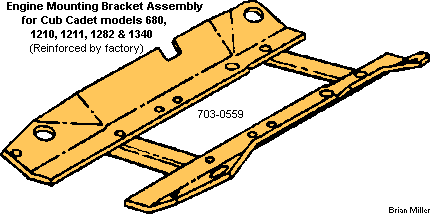
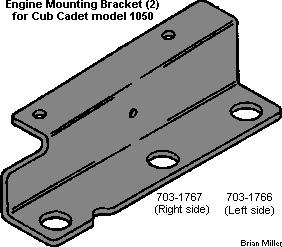

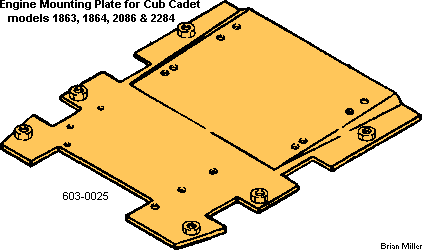
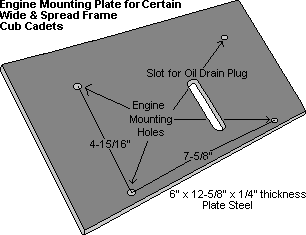
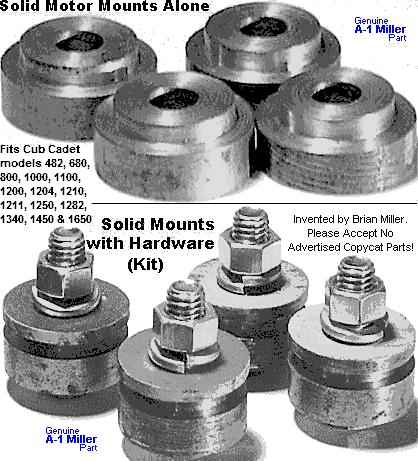
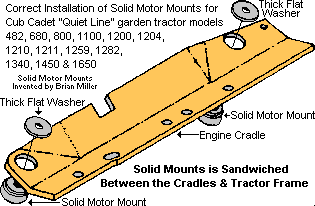 These custom-made solid motor mounts replaces deteriorated
OEM "ISO" rubber engine mounts, which is usually associated with a damaged
"flexible" 3-pin clutch drive plate and damaged clutch components. They are
also a must for competition pulling! Fits IH Cub Cadet "Quiet Line" garden
tractor models 482, 800, 1000, 1100, 1200, 1204, 1210, 1211, 1250, 1282,
1340, 1450 and 1650. If the engine in your tractor is mounted on angled cradles
with rubber mounts between the cradles and tractor frame, then these are
what your tractor need.
These custom-made solid motor mounts replaces deteriorated
OEM "ISO" rubber engine mounts, which is usually associated with a damaged
"flexible" 3-pin clutch drive plate and damaged clutch components. They are
also a must for competition pulling! Fits IH Cub Cadet "Quiet Line" garden
tractor models 482, 800, 1000, 1100, 1200, 1204, 1210, 1211, 1250, 1282,
1340, 1450 and 1650. If the engine in your tractor is mounted on angled cradles
with rubber mounts between the cradles and tractor frame, then these are
what your tractor need.
 Reinforced Rubber Driveshaft
Flex Coupler Disc. Designed specifically for IH Cub Cadet "Original"
garden tractor, and Cub Cadet hydrostatic drive garden tractor models 105,
107, 109, 123, 125, 127, 129, 147, 149 and 169. Cannot be used on the Cub
Cadet "Quiet Line" garden tractor models due to the small center hole. Very
tough, reinforced rubber/weaved composite material. Allows for out-of-alignment
rotation of driveshaft to prevent damage to hydrostatic pump. Can also be
used in a steering shaft setup of a custom-built mini-rod pulling tractor
as a type of U-joint with a maximum 35º rotational angle with coupler
arm(s) listed above. 13/32" bolt holes spaced 3" apart. OEM Cub Cadet part
# IH-376257-R3. $41.20 each, plus shipping & handling.
Reinforced Rubber Driveshaft
Flex Coupler Disc. Designed specifically for IH Cub Cadet "Original"
garden tractor, and Cub Cadet hydrostatic drive garden tractor models 105,
107, 109, 123, 125, 127, 129, 147, 149 and 169. Cannot be used on the Cub
Cadet "Quiet Line" garden tractor models due to the small center hole. Very
tough, reinforced rubber/weaved composite material. Allows for out-of-alignment
rotation of driveshaft to prevent damage to hydrostatic pump. Can also be
used in a steering shaft setup of a custom-built mini-rod pulling tractor
as a type of U-joint with a maximum 35º rotational angle with coupler
arm(s) listed above. 13/32" bolt holes spaced 3" apart. OEM Cub Cadet part
# IH-376257-R3. $41.20 each, plus shipping & handling.

 Professionally Machine
YOUR OEM Cub Cadet garden tractor drive clutch pressure plates. Service
Include: Resurface both clutch contact areas in my metal lathe until perfectly
flat with a slick, smooth surface so a new clutch friction disc will adhere
100% to prevent slippage; true-up outer edge in my metal lathe to prevent
wobble and out-of-balance rotation (which will cause the pilot bushing to
wear); and grind out worn slot(s) in rear hub until straight so clutch disc
will release easier. $30.00 labor for two pressure plates, plus return
shipping & handling.
Professionally Machine
YOUR OEM Cub Cadet garden tractor drive clutch pressure plates. Service
Include: Resurface both clutch contact areas in my metal lathe until perfectly
flat with a slick, smooth surface so a new clutch friction disc will adhere
100% to prevent slippage; true-up outer edge in my metal lathe to prevent
wobble and out-of-balance rotation (which will cause the pilot bushing to
wear); and grind out worn slot(s) in rear hub until straight so clutch disc
will release easier. $30.00 labor for two pressure plates, plus return
shipping & handling.

 Clevis/Hinge/Pivot Pins for
clutch
Clevis/Hinge/Pivot Pins for
clutch 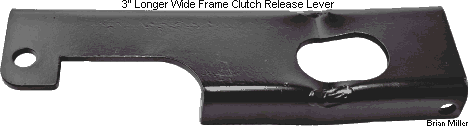
 Clutch Release Levers. Each fits Cub Cadet wide frame garden
tractor models 86, 108 and 128, but can be used in models 800, 1000 and 1200
with
Clutch Release Levers. Each fits Cub Cadet wide frame garden
tractor models 86, 108 and 128, but can be used in models 800, 1000 and 1200
with  Clutch Release Levers. Each fits Cub Cadet wide frame garden
tractor models 800, 1000 and 1200, but can be used in models 86, 108 and
128 with no modifications. Also fits models 1250, 1450 and 1650 with a
hydrostatic disconnect attachment.
Clutch Release Levers. Each fits Cub Cadet wide frame garden
tractor models 800, 1000 and 1200, but can be used in models 86, 108 and
128 with no modifications. Also fits models 1250, 1450 and 1650 with a
hydrostatic disconnect attachment.

 Clutch Release Levers. Each
fits IH- and MTD-built Cub Cadet spread frame garden tractor models 580,
582, 1050, 1535, 1604, 1606 and 1806.
Clutch Release Levers. Each
fits IH- and MTD-built Cub Cadet spread frame garden tractor models 580,
582, 1050, 1535, 1604, 1606 and 1806.
 Clutch Adjustment/Release Rod.
Fits Cub Cadet garden tractor models 70, 71, 72, 73, 100, 102, 104, 106,
122, 124 and 126. Washer welded on rod; can be used for general yard and
garden work or competition pulling
Clutch Adjustment/Release Rod.
Fits Cub Cadet garden tractor models 70, 71, 72, 73, 100, 102, 104, 106,
122, 124 and 126. Washer welded on rod; can be used for general yard and
garden work or competition pulling Clutch Adjustment/Release Rods.
Each fits Cub Cadet garden tractor models 86, 108, 128, 800, 1000 and 1200
(models 800, 1000 and 1200 with caliper/axle brakes.) Washer welded on rod;
can be used for general yard and garden work or competition
pulling
Clutch Adjustment/Release Rods.
Each fits Cub Cadet garden tractor models 86, 108, 128, 800, 1000 and 1200
(models 800, 1000 and 1200 with caliper/axle brakes.) Washer welded on rod;
can be used for general yard and garden work or competition
pulling Clutch Adjustment/Release Rod.
Fits Cub Cadet garden tractor models 580, 582, 1050, 1535, 1604, 1606 and
1806. Washer welded on rod; can be used for general yard and garden work
or competition pulling
Clutch Adjustment/Release Rod.
Fits Cub Cadet garden tractor models 580, 582, 1050, 1535, 1604, 1606 and
1806. Washer welded on rod; can be used for general yard and garden work
or competition pulling Clutch Release/Throw-Out Bearing.
Fits and designed for IH Cub Cadet wide frame/solid mounted engine garden
tractor models 86, 108 and 128. Precision, high-speed sealed collar bearing
w/short pressed-in steel sleeve. This larger diameter bearing covers more
area in the wide frame
Clutch Release/Throw-Out Bearing.
Fits and designed for IH Cub Cadet wide frame/solid mounted engine garden
tractor models 86, 108 and 128. Precision, high-speed sealed collar bearing
w/short pressed-in steel sleeve. This larger diameter bearing covers more
area in the wide frame  Lubricating Sleeve with
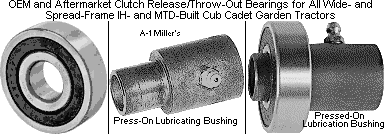 Clutch Release/Throw-Out Bearings
with or without Bushing/Sleeve. Fits and designed for certain Cub Cadet "Quiet
Line" ISO-mounted engine garden tractor models 800, 1000, 1200, including
Cub Cadet models 1250, 1450 and 1650 with hydrostatic disconnect attachment.
Also fits Cub Cadet models 580, 582, 1050, 1535, 1604, 1606 and 1806. Bearing
dimensions: .780" I.D. x 1.850" O.D. x .550" height. This larger diameter
bearing covers more area in the wide and spread frame
Clutch Release/Throw-Out Bearings
with or without Bushing/Sleeve. Fits and designed for certain Cub Cadet "Quiet
Line" ISO-mounted engine garden tractor models 800, 1000, 1200, including
Cub Cadet models 1250, 1450 and 1650 with hydrostatic disconnect attachment.
Also fits Cub Cadet models 580, 582, 1050, 1535, 1604, 1606 and 1806. Bearing
dimensions: .780" I.D. x 1.850" O.D. x .550" height. This larger diameter
bearing covers more area in the wide and spread frame
 Steel Flat Washer for OEM, 800
lb. or 1,150 lb. clutch pressure springs listed above. Prevents end of spring
from possibly uncoiling around 3rd coiled/spiral pin. Not required when spring
is used with 3/4" steel spacer or
Steel Flat Washer for OEM, 800
lb. or 1,150 lb. clutch pressure springs listed above. Prevents end of spring
from possibly uncoiling around 3rd coiled/spiral pin. Not required when spring
is used with 3/4" steel spacer or  Spherical, Swivel, Self-Aligning
5/8" I.D. Set Screw Collar Sealed Ball Bearing with two-bolt, two-piece stamped
steel retainers. Retainers has 2-1/2" bolt hole spacing. Alternative to using
bearing assembly above. High quality aftermarket. Replaces discontinued Cub
Cadet part #'s IH-468390-R93 (collar bearing), IH-468391-R11 (eccentric locking
collar) and IH-376272-R1 (retainers). $25.00 each, plus shipping &
handling.
Spherical, Swivel, Self-Aligning
5/8" I.D. Set Screw Collar Sealed Ball Bearing with two-bolt, two-piece stamped
steel retainers. Retainers has 2-1/2" bolt hole spacing. Alternative to using
bearing assembly above. High quality aftermarket. Replaces discontinued Cub
Cadet part #'s IH-468390-R93 (collar bearing), IH-468391-R11 (eccentric locking
collar) and IH-376272-R1 (retainers). $25.00 each, plus shipping &
handling.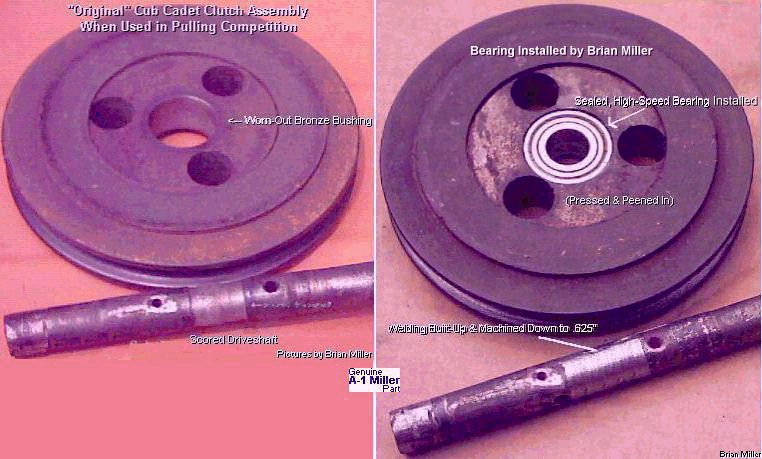
 Mechanical PTO Clutch Rebuild
Kit. Designed for and fits wide frame Cub Cadet models 86, 108, 109, 128,
129, 149 and 169. (Unlike the tractors listed above, the model of tractors
listed here have a larger mower deck, which require more pressure for the
PTO clutch.) OEM Cub Cadet part #'s 75903489 and IH-548352-R92.
$121.00 each, plus shipping & handling.
Mechanical PTO Clutch Rebuild
Kit. Designed for and fits wide frame Cub Cadet models 86, 108, 109, 128,
129, 149 and 169. (Unlike the tractors listed above, the model of tractors
listed here have a larger mower deck, which require more pressure for the
PTO clutch.) OEM Cub Cadet part #'s 75903489 and IH-548352-R92.
$121.00 each, plus shipping & handling.